Your horse’s hooves are their foundation, so taking good care of them is essential for your horse’s health and wellbeing. With good care and a regular cleaning routine, you can keep your horse’s hooves strong and resilient so they can continue to live a happy and active lifestyle. In this guide, we will delve into all the essential aspects of hoof care, from understanding the anatomy of the hoof to mastering the art of regular maintenance and recognizing potential issues. We’ll cover:
- Horse hoof anatomy
- A healthy hoof
- Horse hoof care
- Cleaning
- Nutrition
- Mucking out and stable management
- Exercise
- Seasonal care
- Hoof oil
- Shoeing
- Trimming
- Common horse hoof problems
- Bruising
- Abscesses
- Thrush
- Laminitis
Horse hoof anatomy
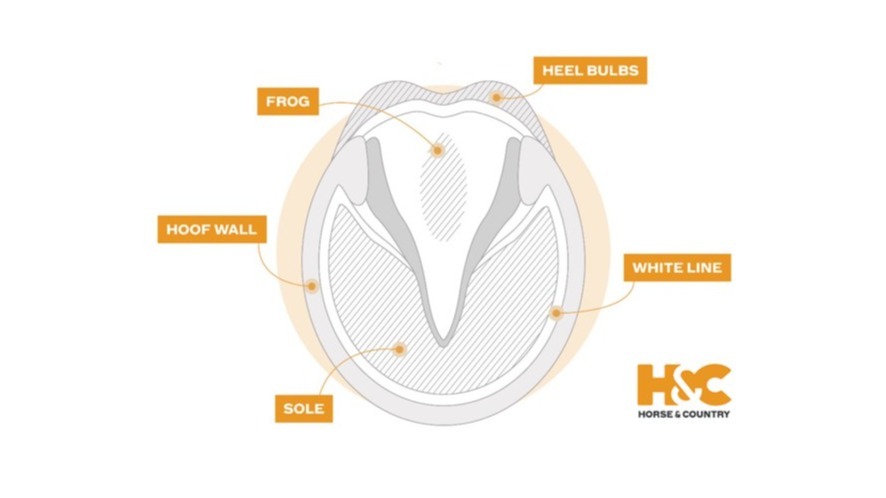
To be able to take care of your horse’s hooves effectively, it’s important to know which part is which. Below is a brief overview of the main parts of a horse’s hoof that you’ll need to know about for regular maintenance and routine care.
Coronary band
This is the small band located where the hairline of the leg meets the hoof. The coronary band has a rich supply of blood vessels and is responsible for creating the hoof wall.
Hoof wall
Sometimes called the horn, the hoof wall is the main exterior part of the hoof that you’ll see when your horse is standing. The hoof wall is made from keratin, which is the same substance that human hair and nails are made from. This hard outer layer helps to protect the internal structure of the hoof. It can take around 9–12 months for the hoof wall to grow from the coronary band to the toe.
Sole
The sole is the underside of the horse’s foot and is made from the same substance as the hoof wall. It protects the internal parts of the hoof which are more sensitive. The sole has a slightly concave shape which helps it to absorb the impact from the ground, however, it doesn’t come into direct contact with the ground.
Frog
The frog is a triangular structure located at the top of the sole and helps to absorb impact, provide grip, bear the horse’s weight, and help with circulation. This part of the hoof does come into contact with the ground and is highly sensitive to help the horse feel the surface.
Heel bulbs
The heel bulbs are made from a similar substance as the frog and help absorb impact from the ground. The bulbs also offer flexibility to the hoof, moving up or down, or in and out, to support the foot on uneven surfaces.
The white line
The white line is the part of the hoof where the hoof wall meets the sole, on the underside of the foot. It’s the only visible part of the hoof’s inner structure and can indicate the health of the inner hoof (known as laminae). If the white line becomes impaired in any way, it could lead to infection.
A healthy hoof
Your horse’s hooves can be a good indicator of their general health and wellbeing. To be able to spot any potential problems, it’s important to familiarise yourself with what a healthy hoof looks like. The front hooves should be slightly larger than the hind hooves, as the front legs tend to bear more weight. When standing on a flat surface, your horse’s hooves should slope at a 45° angle.
The hoof should be free of any cracks or lines. If you do notice any issues, this could be a sign of poor nutrition, laminitis, or another hoof condition. You can learn more about these below. If you’re worried about the conformation of your horse’s hooves, your farrier should be able to take a look and advise the best course of action.
Horse hoof care
With a healthy diet and regular cleaning you can help protect your horse’s hooves, keeping them in good condition and helping to prevent any injuries or problems. Below are some essential horse hoof care tips to help you look after your horse’s feet, with some essential advice from the experts.
Cleaning
Your horse’s hooves should be cleaned at least once each day to remove debris which can cause bruising and punctures. This also gives you a good opportunity to check their hooves and spot any potential problems right away. The earlier you respond to signs of injury or illness, the easier it will be to treat. Our horse grooming 101 guide contains a detailed section on cleaning your horse’s hooves, including how to do it safely and any signs of illness or injury to look out for. For even more advice, take a look at our hoof care masterclass with NAF, which shows you how to check your horse’s hooves for signs of infection or injury.
Nutrition
A balanced, high-forage diet is key for ensuring healthy horn growth. We spoke to independent equine nutritionist Clare MacLeod, who gave her tips for feeding your horse to ensure adequate hoof health.
“If you’re feeding a handful of nuts per day and your horse is at grass you might think he’s getting enough,” Clare says. “But unless you are feeding the required amount according to the manufacturer, they’re not getting sufficient minerals and vitamins.”
Clare recommends feeding a multi-spectrum vitamin and mineral supplement or balancer. You can find out more about the essential vitamins and minerals required for optimum hoof health in our guide to horse supplements.
Mucking out and stable management
Good stable management can help keep your horse’s hooves healthy, so be sure to keep your horse’s bed clean and dry. “Urine contains ammonia which will attack the horn structure,” says Andrew Poynton, executive member and examiner for the Worshipful Company of Farriers (WCF). He also recommends using straw as it doesn’t ball up in the horses’ feet (which can draw out moisture) and allows air to circulate.
Exercise
It’s important that your horse gets plenty of exercise for many reasons, one of which being their hoof health. Exercise helps to stimulate blood circulation to the hooves which can keep them healthy and strong. Even if your horse is being stabled for long periods of time, such as in winter, it’s vital that they get enough exercise. If you can’t take them outside or ride them, you can still do some simple in-hand exercises or pole work in an indoor arena.
Seasonal care
The seasons can greatly impact your horse’s hooves. The hard, dry ground in summer can make hooves dry out quickly, which can lead to cracking, infection, and lameness if not prevented or treated. It’s a good idea to apply a hoof oil every day in dry weather to keep the horn moisturised and in good condition. Watch our Back to Basics: Shoeing and Hoof Care series with NAF for advice on the best hoof products to use.
The hard ground can also add extra pressure to your horse’s hooves. Master farrier Marc Jerram suggests pads to help shod horses cope with the impact, while barefoot horses may need to wear hoof boots. For more information, take a look at our tips on caring for horses in hot weather.
Alternatively, in winter, the wet and cold ground can add extra moisture to your horse’s hooves, causing them to soften. For this reason, you should make sure they always have a dry, hard area for them to stand in away from the mud and give time for their hooves to dry out if they’ve been standing out in the mud for a long period of time. Take a look at our guide to caring for your horse in winter for more advice.
Frequent changes in the weather can also have an impact on your horse’s hooves. Our unpredictable weather, which can often change from dry to wet and dry again, can weaken the hoof horn. Master farrier Wayne Upton says applying a product containing animal or vegetable grease to a clean hoof will protect it. “Make sure you also apply plenty under the hairline, onto the coronary band,” he says. “If you look after new growth the foot will become healthier.”
Shoeing
Horseshoes help to strengthen and protect the horse’s hooves, stopping them from wearing down too quickly. Not all horses need to wear horseshoes, but working horses and those who are particularly active may benefit, as the continual movement could wear their hooves down too fast. Shoes can also help protect the feet from impact, so horses that take part in high-impact events like jumping or cross country might benefit from shoeing. Some horses may also need shoes to relieve pressure and restore healthy function in their hooves. You can find out more about this in our Back to Basics episode on remedial shoeing.
Horseshoes can become loose or wear down over time, so horses generally need to be re-shod around every six weeks — although, this can depend entirely on your horse’s activity levels and hoof growth. During the re-shoeing process, the farrier will also trim and reshape your horse’s hooves. You can find out more about the process in our detailed guide to horse shoeing and watch it in action in our dressing and shoeing episode of Back to Basics: Shoeing & Hoof Care with NAF.
Trimming
Just as our hair and fingernails grow, horses’ hooves are continuously growing. Regular exercise can help to wear them down naturally, which is why very active wild horses don’t need their hooves trimming. However, domestic horses will need their hooves trimmed regularly to stop them from becoming overgrown. How often this needs to be done depends on whether your horse is shod or not, as well as how fast their hooves grow. As a rule of thumb, unshod horses will need their hooves trimmed by a farrier around every four weeks or so, while shod horses can get away with a little longer at around six weeks. Once your farrier is familiar with your horse’s hooves, they should be able to recommend how often they need trimming.
But how do you know if your farrier is doing a good job? Master farrier Wayne Upton suggests checking the clenches after your horse has been shod. “These are the shop window for farriers,” he says. “If they’ve taken the trouble to make them look nice then it generally means the horse has been shod well. They should be small and tight, with a neat finish.”
Common horse hoof problems
Horses spend most of their lives on their feet, so it’s vital to take good care of their hooves and identify any signs of illness or injury. Hooves can be prone to various conditions, and both yourself and your farrier should check your horse’s hooves regularly to help protect against damage.
Bruising
Bruising occurs when blood vessels in the hoof tissue rupture. This is caused by trauma to the hoof, such as standing on a sharp stone, stomping on hard ground, or improper shoeing or farrier work. If your horse has a bruised hoof they may show some sensitivity in the area, as well as a visible bruise. If the bruising is severe, the horse may even be lame.
The good news is that hoof bruising generally heals after a period of rest, so be sure to give them a break from training while they recover. Some horses may need a protective covering in the form of boots, pads, or wraps to offer more cushioning and comfort during healing. Be sure to keep an eye on your horse’s injury too, as bruising can be a breeding ground for bacteria which can lead to an abscess.
Abscesses
An abscess forms when pus builds up in the horse’s hoof due to a bacterial infection. An infection can enter the hoof as a result of bruising, or it can enter through the white line. Horse hoof abscess symptoms might include sudden lameness in one leg, or the area may feel hotter than the other feet with some extra pressure.
If you notice symptoms of an abscess in your horse’s hoof, you should let them rest and immediately call an equine vet. The vet will be able to confirm whether it is indeed an abscess and check for other signs of injury. If it is an abscess, they will try to drain the pus from the wound either by using a hoof knife or by applying a poultice to the wound.
In most cases, your horse should make a full recovery from a hoof abscess relatively quickly. If your horse is prone to hoof abscesses, then it’s worth speaking to your vet to investigate the cause. It could be that their living conditions are too damp or muddy, or they may have an underlying condition such as pituitary pars intermedia dysfunction (PPID), also known as Cushing’s disease, which may need treatment.
Thrush
Thrush is a bacterial infection that commonly affects the soft tissue of the frog area. The main cause is prolonged exposure to damp and muddy conditions and improper hoof hygiene. Horses with long heel conformation are also more prone to thrush as their deep and narrow frog cleft can trap dirt and bacteria.
Symptoms of horse hoof thrush include a dark smelly discharge and lameness in the affected foot or feet. If left untreated, thrush can spread throughout the whole hoof, so it’s important to act straight away if you notice any symptoms. Let your horse rest in a dry place and call a vet or farrier, who will remove the affected tissue. The area should then be picked out and cleaned with a dilute iodine solution twice each day until the infection clears. With the correct treatment, your horse should make a full recovery within two weeks.
Laminitis
Laminitis is a painful condition in which the sensitive tissues that connect the hoof wall to the pedal bone (known as laminae) become inflamed. Cases can range from mild to severe, but if left untreated it can cause the pedal bone to become separated from the hoof wall, so it should always be treated as an emergency if you suspect your horse has laminitis.
Symptoms of laminitis include shifting weight from foot to foot, a reluctance to walk or pick up their feet, a hoof that is hot to the touch for more than two hours, or visible lameness. You can find out more about laminitis, including its causes and how to prevent it, in the first episode of our Vet Essentials series.
Your horse’s hooves are one of their most important assets, so taking good care of them is vital. This guide should prepare you for the basics of hoof care, but if you’re ever concerned, be sure to call a vet or farrier. For even more essential horse care guidance, take a look at our advice section or browse our wide range of exclusive equestrian series and shows which includes training and advice from the experts. Become a member of H&C+ today to start watching.