Good horse conformation vs bad
The term ‘horse conformation’ refers to the physical structure of your horse’s body and its proportions and alignment. It’s closely related to your horse’s athletic ability and can determine how well it can perform certain tasks or how high its risk of injury might be.
If you’re in the process of buying a horse, particularly if you’re buying a horse for a certain sport, you’ll want to pay close attention to the horse’s conformation to make sure they can carry out the tasks and exercises you want them to safely and effectively. This is usually done during the vetting procedure.
Ideal horse conformation generally means balanced proportions, strong limbs, correct angles, and good muscling for the horse’s intended use. Poor conformation can cause poor gait and lead to weaknesses or lameness over time. If you notice any signs of bad conformation in your horse, it’s best to seek the advice of a vet to rule out any possible health problems or to create a treatment plan to ease any discomfort.
So what is good horse conformation, and what might bad conformation look like?
- Leg conformation
- Hoof conformation
- Shoulder conformation
- Neck conformation
- Head conformation
- Body conformtation
- Hindquarter conformation

Leg conformation
Good horse leg conformation means straight, correctly aligned limbs when viewed from the front, side, and rear. They should have well-defined joints with no swelling or abnormalities and short cannon bones with longer forearms, as this provides strength.
Hocks should be well aligned with the leg. When viewed from the side, a straight line should run from the point of the buttock down through the hock, fetlock, and hoof. When viewed from behind, the hocks should be in line with the stifles and cannon bones, without turning in or out.
Bad leg conformation
Common horse conformation faults include:
-
- Knock-knees: Knees angle inward, putting stress on the knee joints.
- Bow legs: Knees angle outward and lower limbs angle inward, reducing stability.
- Toeing-in (pigeon-toes): Hooves point inward, leading to paddling (outward swinging movement).
- Toeing-out (splayed-footed): Hooves point outward, causing winging (inward swinging movement).
- Sickle hocked: The hock is overly angled, causing strain on tendons and ligaments and increasing the risk of injury and arthritis.
- Post-legged: The hock has too little angle, making the leg stiff and upright, which can reduce shock absorption and result in stiff movement.
Hoof conformation
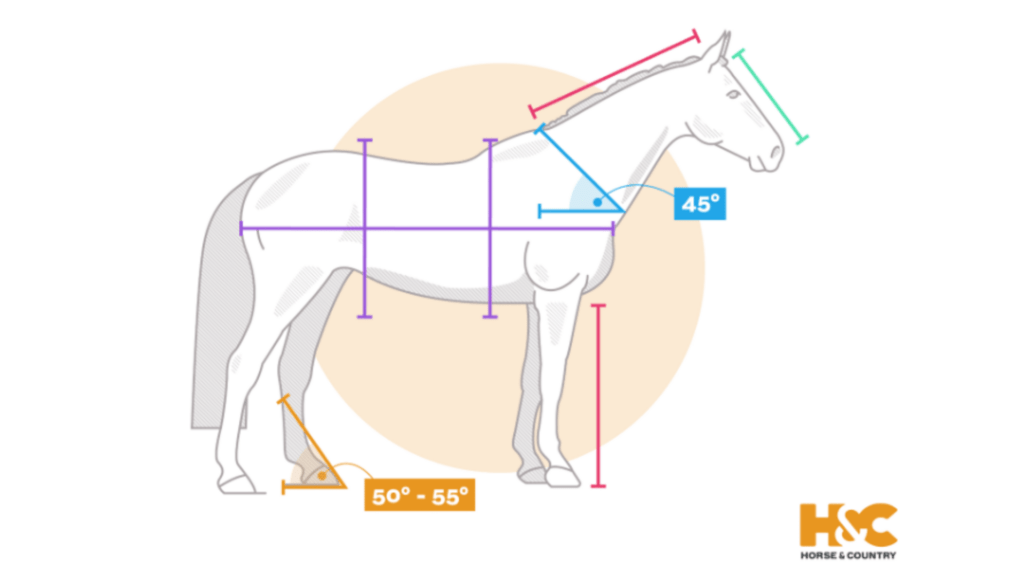
Hooves should be proportional to the horse’s body size, with a well-shaped heel and toe. The pasterns should be at a moderate angle (shown in orange) for shock absorption. As a general rule of thumb, this is around 45–50° in the front legs and 50–55° in the hind legs. Jumping and dressage horses may have slightly longer pasterns to allow for better flexion and smoother movement.
Bad hoof conformation
- Club foot: Pasterns are too upright and can’t absorb shock as effectively. This can lead to lameness.
- Long pasterns: Can weaken support and cause strain on tendons, increasing the risk of injury.
Shoulder conformation
Good horse shoulder conformation means well-sloped shoulders that are ideally around 45–50° when the horse stands square (shown in blue). This allows for smooth movement and a long, free stride. The horse’s elbows should be in alignment with the withers.
Bad shoulder conformation
- Steep shoulders: The angle of the shoulders is too upright (under 45°), which results in short, choppy strides and poor reach.
- Laid-back shoulders: The angle of the shoulders is too sloped (over 50°), which can reduce power and affect collection. Horses with laid-back shoulders are well-suited to dressage but may struggle with jumping.
Neck conformation
The neck is a well-proportioned length, around the same length as the front leg (shown in red above) or one-third of its body length. It should be slightly arched, tie smoothly into the shoulder, and neither too thick nor too thin, allowing for good balance and flexibility. A longer, more arched neck allows for better balance and collection, which is perfect for dressage and jumping horses.
Bad neck conformation
-
- Ewe neck: The neck appears to have an upside-down curve. This denotes a lack of strength and balance, making collection difficult.
- Thick, short neck: Restricts flexibility and responsiveness.
- Swan neck: The top part of the neck has an excessive arch and a weak lower neck and topline. You can help a horse with swan neck using pole work to build their topline as well as focusing on neck stretches.
Head conformation
The head (measured from the poll to the tip of the muzzle, as shown in green) should be proportionate to the body, with a refined and symmetrical shape. The horse should have large, expressive eyes set wide apart for good vision and well-formed nostrils for optimal airflow.
Bad head conformation
- Roman nose: A bulging nasal bone. This can make the head heavier and reduce balance and agility. It may also make the muzzle less sensitive to pressure.
- Pig eyes: Small, deep-set eyes that can limit peripheral vision, making the horse more spooky, nervous, or reactive. It can also make it more difficult for a horse to navigate jumps and tricky terrain.
- Parrot mouth: The upper jaw extends beyond the lower jaw. This can lead to difficulty grazing, as the teeth don’t align properly, and can cause uneven wear on the incisors. Horses with parrot mouth may require frequent dental care to prevent discomfort and chewing issues.
- Sow mouth: The lower jaw extends beyond the upper jaw, which can cause chewing difficulties. Like parrot mouth, horses with sow mouth may need regular dental maintenance.
Body conformation
Your horse should have a balanced, square body. This means the height of the horse, measured from the withers to the ground, should be equal to the length of the body. Check that their forequarter, midsection, and hindquarter are in proportion — good conformation means the horse’s body can be divided into roughly equal thirds when viewed from the side (shown in purple).
Look for a strong topline with a well-muscled back and loin for power and a deep, well-sprung ribcage for lung capacity. A well-angled croup and strong hindquarters are also important for power and drive.
Bad body conformation
- Long, weak back: Reduces power and increases the risk of strain.
- Short, overly compact back: Can limit flexibility and fluidity in movement.
- Roach back (arched back): The spine curves upwards, especially towards the loin area. This can cause stiffness, reduce performance, and affect saddle fit. You can find out more about this in episode two of our Fit For Welfare series.
- Swayback: An excessive dip in the back that is particularly common in older horses and weakens the topline.
Hindquarter conformation
A well-built hindquarter allows for efficient movement, strong engagement, and long-term soundness. A horse with ideal hindquarter conformation will have a well-muscled, proportionate, and correctly angled pelvis that is in line with the withers.
Bad hindquarter conformation
- Weak or sloping hindquarters: Lacks muscle tone, reducing power and propulsion. It can also make collection and engagement difficult, especially in dressage.
- Goose-rumped: A steep croup which causes excessive hock engagement, this can place stress on joints and lead to extension difficulty.
- Flat croup: A shallow pelvis which reduces hind-end engagement and push-off power. Leads to shorter strides and less efficient movement.
- Cow-hocked: Hocks angle inward, leading to strain and inefficient movement. It can also increase the risk of lameness.
Understanding horse conformation is essential for evaluating soundness, performance, and long-term health, especially if you’ll be competing with your horse. Remember, no horse is perfect, and ideal conformation entirely depends on the horse’s breed, discipline, and intended use. Structural weaknesses and conformation faults can also often be managed through conditioning, healthcare, and correct training techniques. Become a H&C member today to get access to all of our expert training videos plus exclusive coverage of live events.