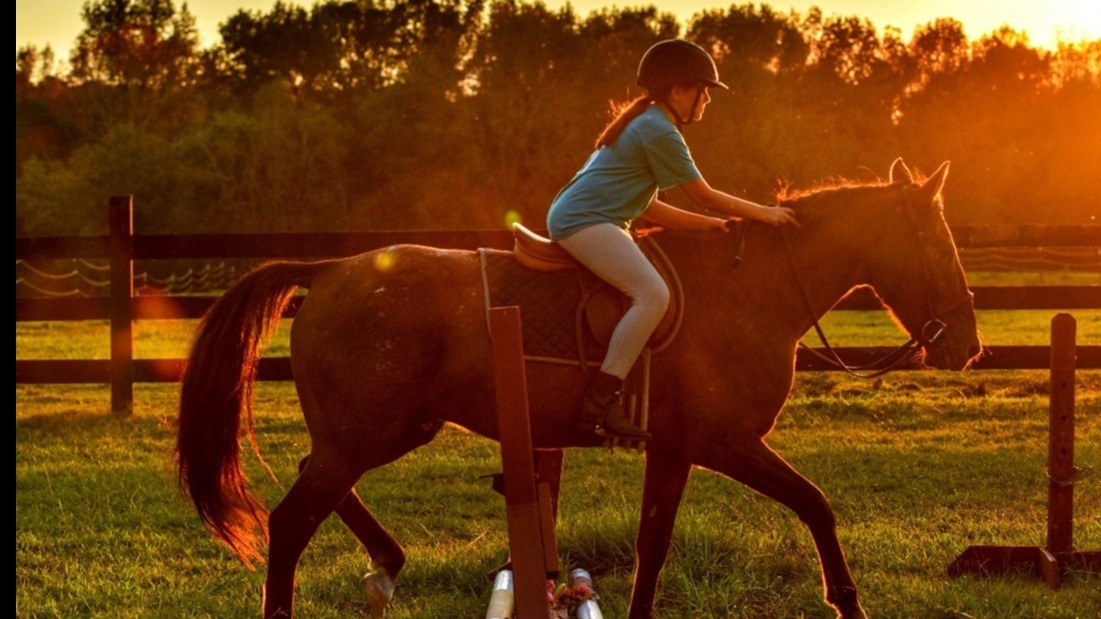
No matter what kind of rider you are, whether you’re into dressage, showjumping, or eventing, you’ll no doubt be looking for ways to make your horse stronger, more balanced and more supple. Polework is a great way to focus on these key areas, all while adding some fun and variety into your training routine to keep your horse active and engaged.
If you’re keen to incorporate some muscle-building polework into your routine, this guide is for you. Here, we’ll show you exactly what polework is, how to do it correctly, plus our favourite ground pole patterns to try out. We’ll cover:
- What is pole work for horses?
- Ground pole distances for horses
- Beginner pole work exercises for horses
- The line
- The fan
- The circle
- The square
- Intermediate pole work exercises for horses
- Raised poles
- The double fan
- The spiral
- The clover

What is pole work for horses?
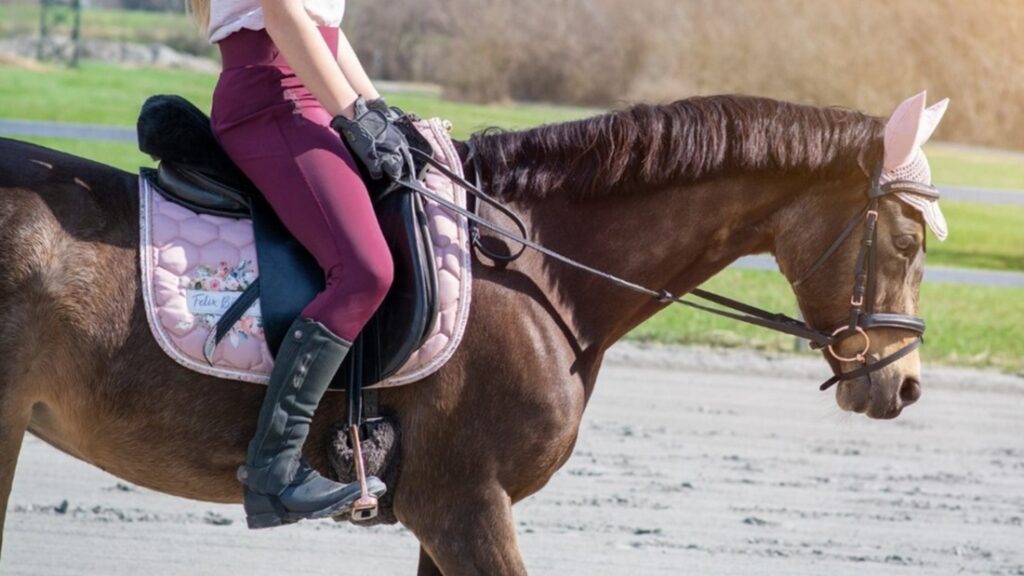
Pole work exercises involve laying a series of poles on the ground (or slightly raised from the ground) at a set distance apart. You can then instruct your horse to walk, trot, or canter over or between the poles without knocking them, aiming for the same number of strides between each pole. Every exercise should be repeated on each rein to work both sides of your horse’s body.
These exercises encourage your horse to engage their hindquarters and side muscles, build their topline, and elongate their stride, all while improving rhythm and balance. If your horse tends to rush forward, pole work is great for teaching them to take things slow and be more controlled.
Each pole work exercise lays the foundations for any discipline, whether that’s dressage or showjumping. They’re also great when used as part of an equine physiotherapy plan, helping to stretch and work certain muscle groups. If you incorporate pole exercises into your training routine, you’ll soon start to see the results in your horse’s form.
Pole exercises may seem simple, but they can be hard work for your horse and can activate new muscles in his body. For this reason, they should be done little and often. Around 15 minutes once or twice a week is enough to train your horse without overworking him.
Ground pole distances for horses
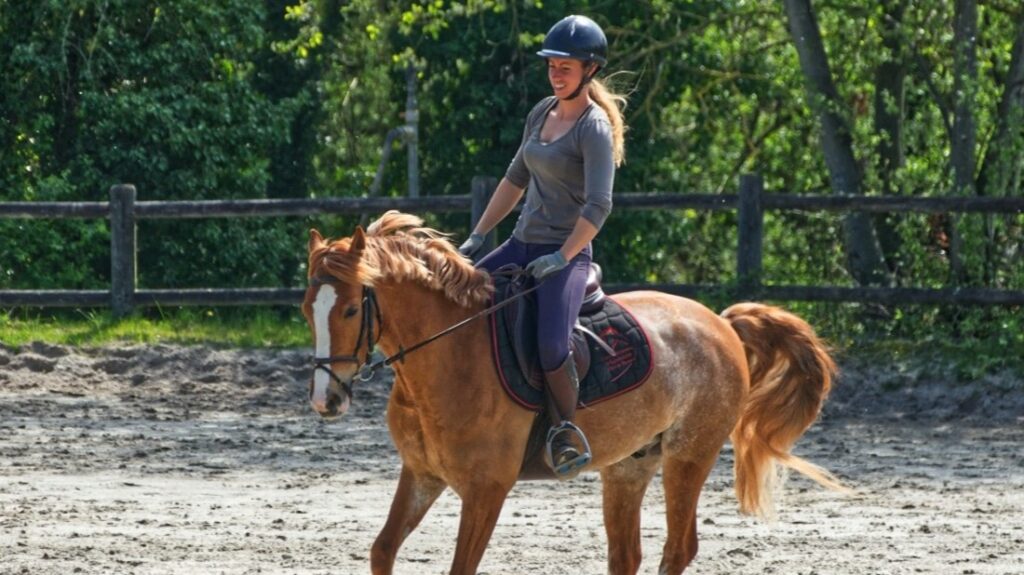
For pole work exercises to be effective, the poles need to be positioned at the correct distance. The closer the poles are together, the more your horse will need to engage his hindquarters, but the further apart the poles are, the more he’ll need to lengthen his stride.
The right ground pole distance can also depend on your horse’s size, weight, and fitness level, as well as the gait you’ll be doing the exercise in. As a rule of thumb, start with your horse’s usual stride and adjust it as needed.
Walking pole distance: Whether you’re just starting pole work for the first time or warming up, be sure to start in a walk. For an average-sized horse, the walking pole distance should be 0.8–1m.
Trotting pole distance: As your horse speeds up, their stride will be longer, so the trotting pole distance should be extended to around 1.2–1.7m.
Canter pole distance: If you’re working in canter, you should extend the ground pole distance even further. Around 2.7–3.4m is a good canter pole distance.
Measuring the distance between the poles with a measuring tape is the most accurate method. However, if you don’t have a measuring tape on hand, you can always get a rough estimate by using your feet. Simply place one foot in front of the other, as if you’re walking on a tightrope. Just be sure to always measure from the centre of the poles to get the most accurate distance.
In-hand vs mounted
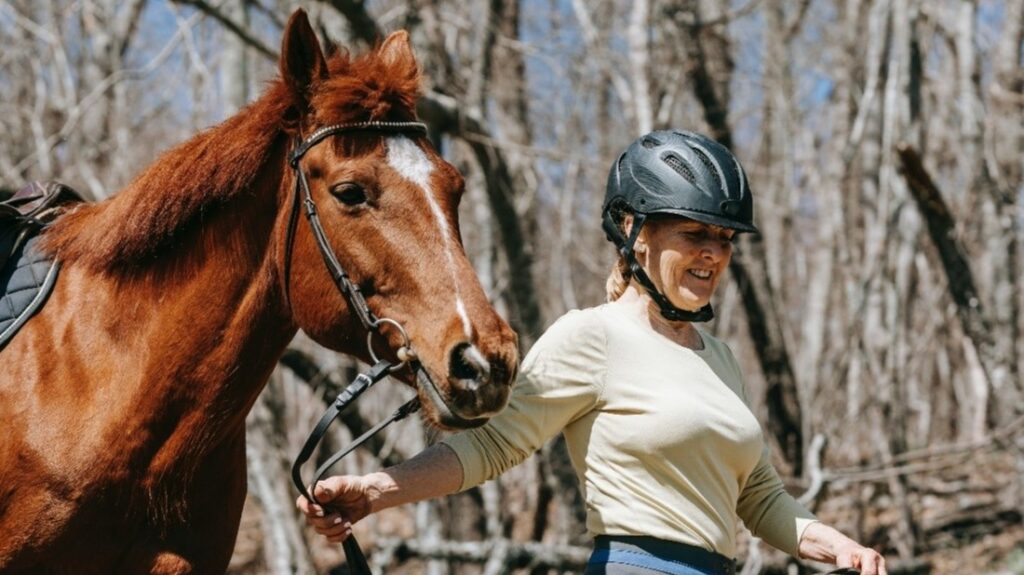
Pole work can be done both in and out of the saddle. It’s down to your preference which option you choose, and you can swap between mounted and unmounted training whenever you wish.
Unmounted pole work exercises may be more effective if you’re looking to improve your horse’s form. You’ll also be able to get a good view of how your horse is moving throughout the session — something that is more difficult to do from the saddle. Your horse is also likely to build muscle along their back, as they will have more freedom to move through their back without the saddle.
Alternatively, mounted pole work exercises are a great opportunity for you to practice your control as a rider, especially if you’re riding more complicated ground pole patterns. Pole exercises require planning, concentration and accurate aids, making them a good option for riders who need to focus on their communication. The weight of the saddle and rider will also help to improve your horse’s strength as they train.
Beginner pole exercises for horses
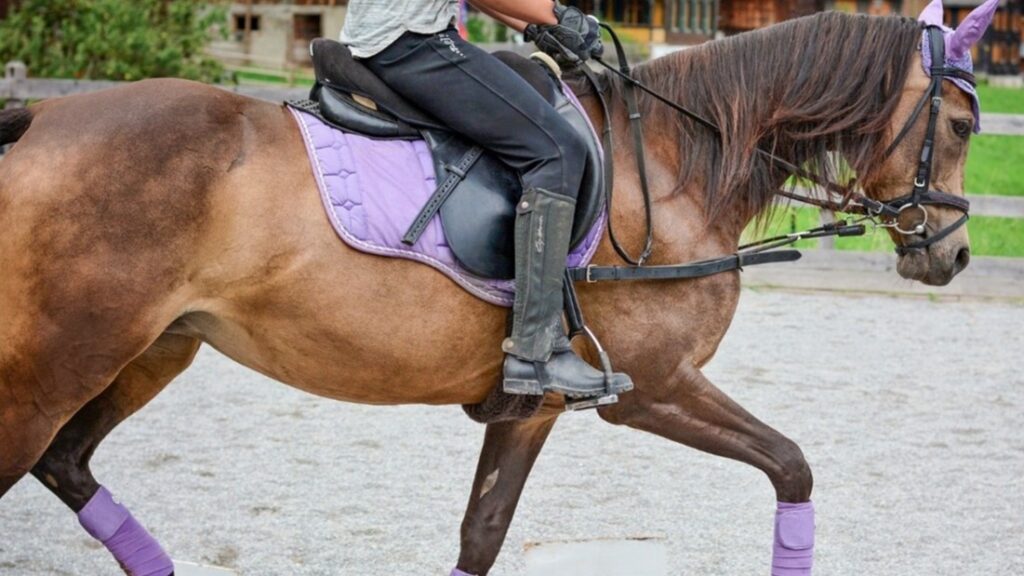
There’s almost no limit to the number of pole work exercises you can try with your horse. However, we always recommend working in accordance with your horse and their abilities, starting off simply and switching to more complicated arrangements as your horse’s fitness and confidence progresses. Be sure to introduce your horse to a new ground pole pattern slowly and try it in a walk until they get used to it. You can then do each exercise in a trot and eventually a canter to work their muscles even more.
Below are some of the best beginner pole exercises for young and green horses. These patterns can also be modified for experienced riders if these are too simple for your horse’s fitness level.
The line
One of the easiest ground pole patterns out there, the line is just as it sounds: a straight line of poles. In walk, trot or canter, ask your horse to navigate the poles. Try to stay in the centre of the poles as you ride through and aim to get an equal number of strides between each one to maintain a steady rhythm.
For complete beginners, start with one pole and then three, before adding more. This will help your horse get used to the feeling of walking between the poles. However, it’s best to go from one pole to three, as your horse may be inclined to jump the poles if there are two.
This exercise is great for introducing horses to pole work, and is particularly useful for showjumpers, improving accuracy and encouraging your horse to stay in the middle of the fence.
You can also modify this exercise slightly by placing the poles on a turn. Check out the third instalment of our Back to Basics series to find out how to do this.
The fan
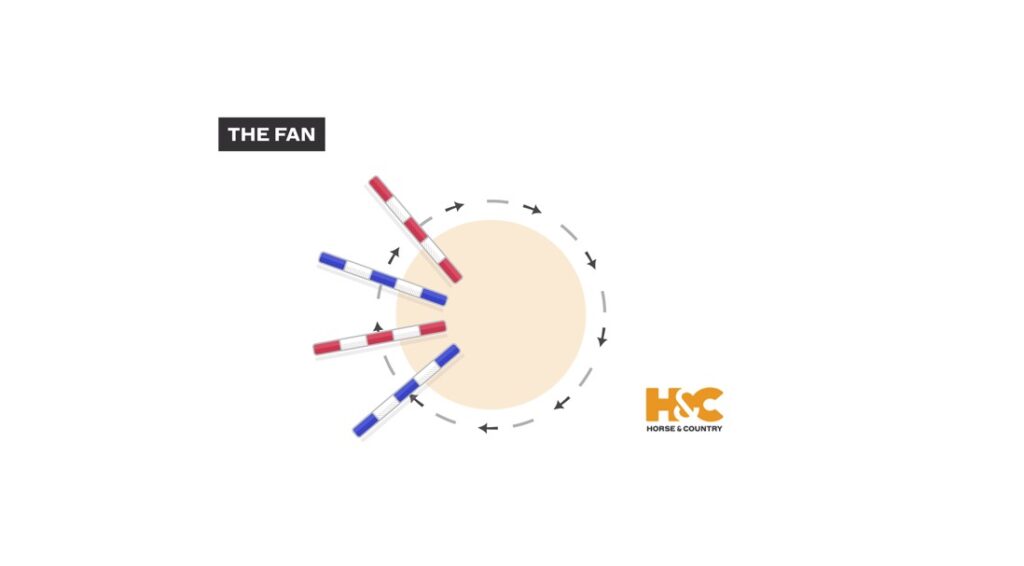
Another favourite pole work exercise for horses is the fan. To do this, lay out four to six poles an equal distance apart to create a fan shape. Each pole should be around one foot apart at the narrow end and around six feet at the wider end.
Instruct your horse to walk over the poles, ensuring they stay in the middle, and circle back around. They should have a slight bend in their body the whole time. This will help your horse develop a balanced rhythm, without falling out through his shoulder as he turns a corner. The fan also makes a great addition to your lunging session.
The circle
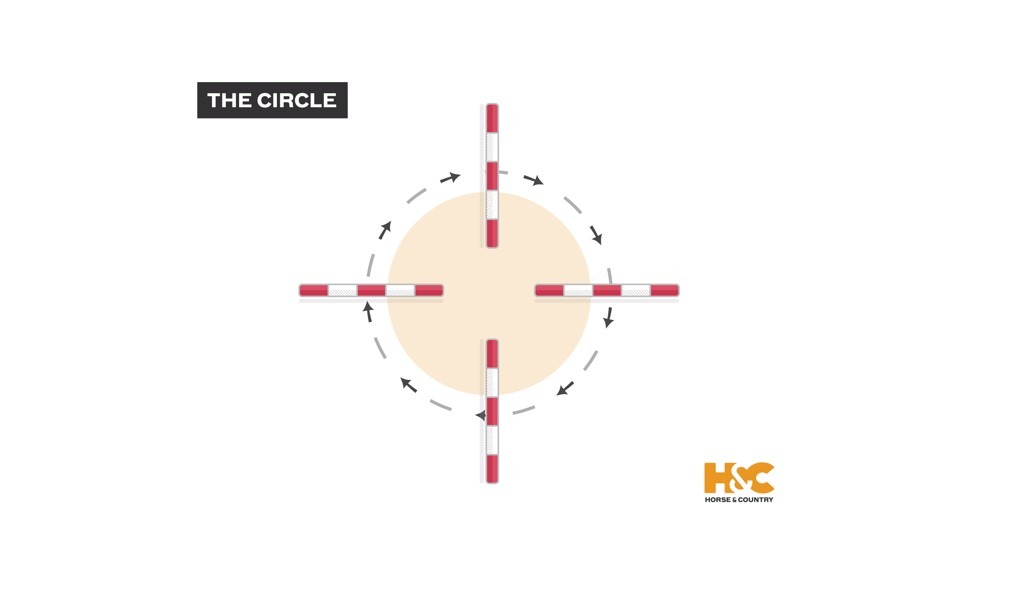
The circle pattern is great for practising bending and developing suppleness, so it makes the perfect addition to dressage training. Start by laying your poles out in a 20cm circle. If you imagine your field or arena is a clock face, you’ll want to place a pole at 3, 6, 9, and 12 o’clock.
Then, there are a few different routes you can take with this. The easiest option is to practice walking or trotting in a circle, making sure to go over the centre of each pole. More experienced horses and riders may choose to turn their training up a notch by riding a figure-of-eight through two opposing poles.
The square
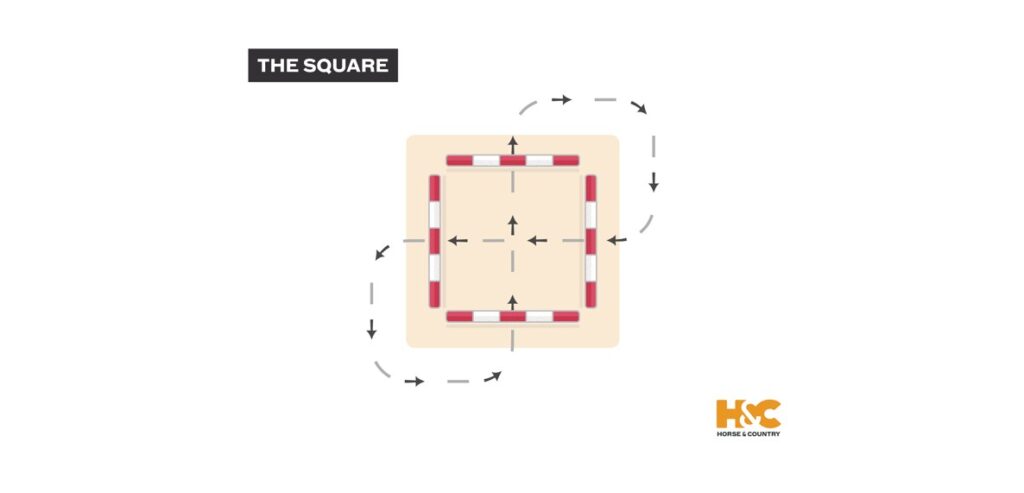
The square is a great exercise that has several variations, so there’s something for any kind of horse and rider. For this groundwork pattern, you’ll need to place four poles on the floor in the shape of a square. One of the simplest iterations of this exercise is to walk from one side of the square to the other, or from one corner to another, to help develop your horse’s straightness.
Another option is to ride in circles at each corner of the square or ride a figure-of-eight pattern from corner to corner (as shown above), both of which will help develop suppleness. The figure-of-eight also helps with flying changes, offering your horse two chances to change direction.
An extra variation of this exercise is to place the poles further apart, creating a larger boundary that you can then circle inside of. You can watch Bobby-Hayler Wright demonstrate how to ride in a circle in our Back to Basics: Dressage series.
Intermediate pole exercises for horses
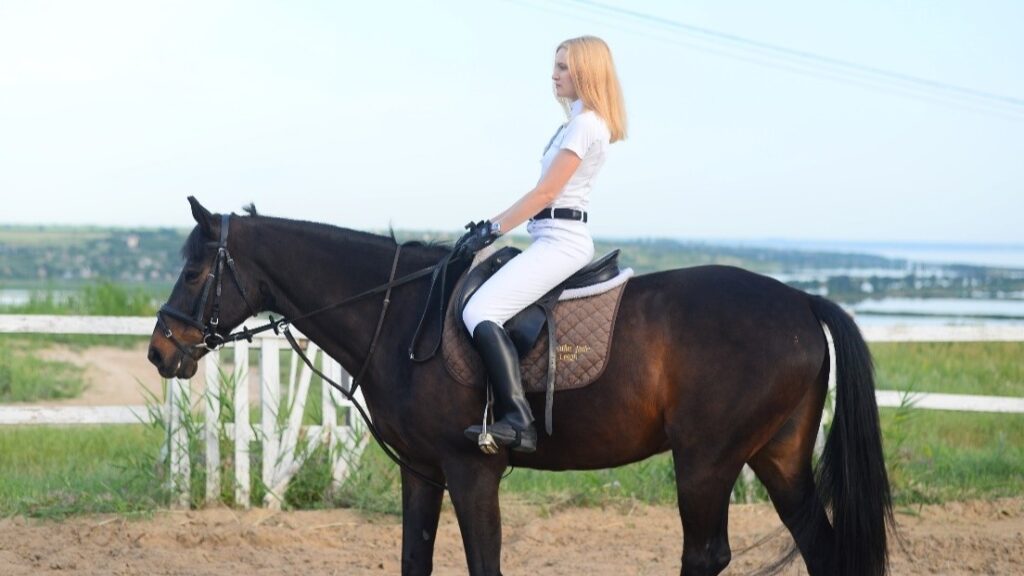
If your horse is well versed in pole work then you may be ready to turn the heat up. Any of the exercises we’ve mentioned above can be adapted to intermediate and advanced riders. Below are just some of the variations you can try to take your horse’s training to the next level.
Raised poles
If you feel like your horse is leaning on your hands too much, it’s important to teach them to engage their hindquarters — particularly if you’re a dressage rider or eventer. Raised pole exercises are great for this, and all of the pole exercises above can be done using raised poles. The line and fan patterns lend themselves especially well to raised pole exercises.
Simply take one end of each pole and rest it on a small block or pole riser. It should be low enough that your horse can still step over it. We’d recommend raising each pole gradually to give your horse time to get used to the new height. Each time you raise a pole, alternate the side you raise.
The double fan
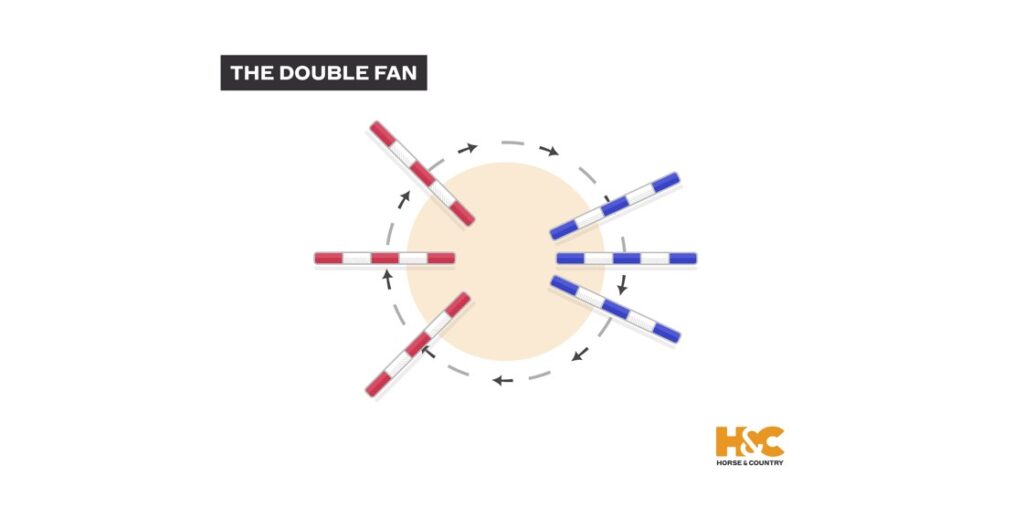
The fan is great for developing a range of skills, including suppleness and rhythm, and you can make this exercise even more effective by creating a double fan. This exercise requires you to work in both trot and canter, making it perfect for practising transitions.
Start with your usual fan pattern for this groundwork exercise, laying each pole at a canter distance apart (3–3.4m). Then, repeat the same on the other side, this time placing the poles at a trotting distance (1.2–1.7m). In a canter, make your way over the first set of poles then slow down to a trot to go over the second set, speeding up again as you make your way back to the canter poles.
The spiral
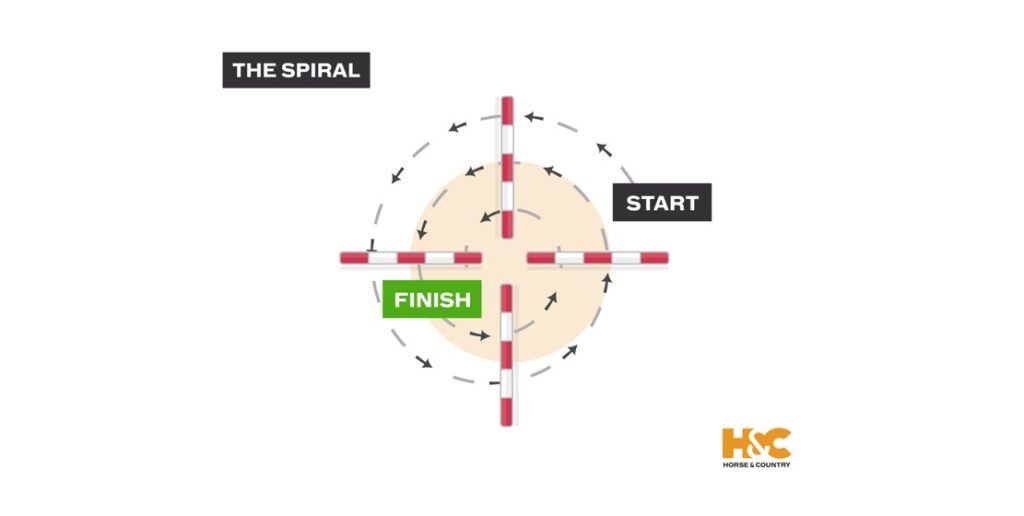
Once your horse is familiar with the circle, you can start to modify your riding slightly to enhance your practice. Refine your horse’s bending by altering the size of the circles you ride in, keeping the poles in the same position each time. You may find that your horse needs more practice stepping over the ends of the poles, as they’ll naturally want to walk around them instead.
If you want to up the ante even more, you can spiral in and out of the circle with a slight leg yield. Although this may sound easy, it can be surprisingly challenging to achieve the right control, whether you’re riding this exercise or doing it in-hand. You might find that your horse struggles to make large circles on one side, which can be an indicator that they like to lean on their opposite shoulder. The spiral can therefore help you identify any problems to make your horse’s form more symmetrical.
Because this exercise can be tricky to execute, it’s often helpful to have someone who can watch and give you guidance on your form. When done right, this exercise can really refine your control and balance.
The clover
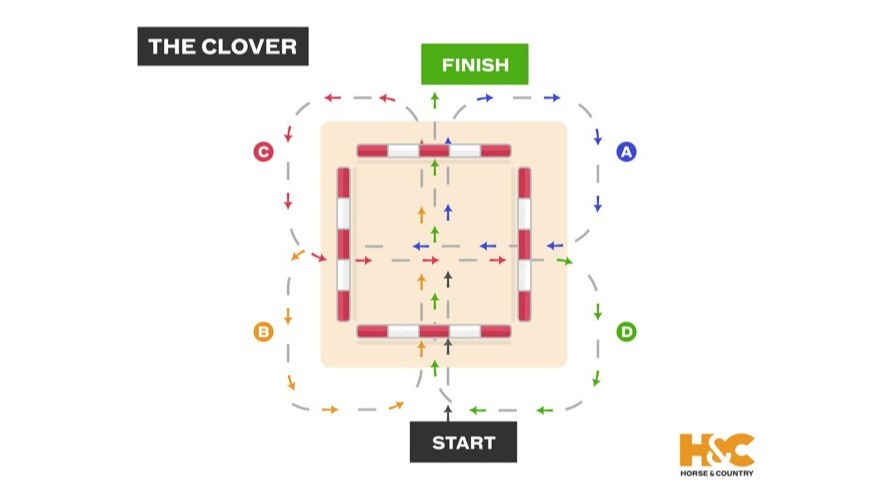
The clover is a more experienced version of the square and will test your horse’s accuracy and rhythm and develop their suppleness. Don’t be put off by its shape — it’s a lot simpler than it looks! It’s more about getting the pattern right.
- Start at the centre of one pole and walk up through the centre line and step over the opposite pole.
- Circle to the right, all the way around and over the pole that forms the right side of the square, perpendicular to the first pole you stepped over.
- Walk straight across the square and over the opposite pole, then turn left and back around to your starting point.
- Step back over the first pole, through the square and over the opposite pole, then turn left.
- Circle around and over the pole that forms the left side of the square, perpendicular to your starting pole, then across to the opposite pole.
- Circle right and back to your starting position.
Top tip: make sure your approach to each pole is accurate to help you keep straight through the box.
To ensure you’re keeping up a good rhythm, aim for four steps inside the box and maintain that same rhythm for your turns. Good execution of this exercise lies in your planning as a rider. Make sure you keep your head up and looking in the direction you want to go in. If you’re looking at the centre of the pole, you’re more likely to ride to the centre. As you’re stepping over the pole, you should already be planning your turn.
Pole work exercises make the perfect accompaniment to any training routine. Whether you’re looking to build your horse’s muscle, make them more supple or improve their straightness, any of these pole exercises for horses will help. They also add some variety to your training, which helps keep things interesting for both you and your horse.
For even more training tips, be sure to take a look at our wide selection of training and advice videos from our expert equestrian partners. Become a member today and you’ll get access to thousands of hours of video content that you can watch from anywhere, plus live coverage of some of the biggest equestrian events. You’ll find even more advice in our news section, too.