Tammi S Epp, DVM, PhD, DACVSMR.
In 3-day eventing and jumping, a horse’s performance depends on its ability to take in and process oxygen efficiently. However, respiratory challenges often go unnoticed despite their significant impact on performance. Unlike the heart and muscles, the lungs don’t adapt to training or selective breeding, making them the biggest bottleneck in equine athleticism.
THE CHALLENGES OF OXYGEN DELIVERY IN COMPETITION
Competition presents multiple breathing challenges, compounded by heat stress that further impairs respiratory efficiency:
- Dressage: Bits, tight girths, and rider-induced poll hyperflexion can restrict airflow.
- Stadium Jumping & Cross-Country: Horses must sustain speed, endurance, and power while tackling 24-to-36-inch obstacles over 2 ¾ to 4 miles of challenging terrain. The higher the competition level, the greater the difficulty—tougher terrain with more technical obstacles. With over 70% of a horse’s energy coming from aerobic metabolism, efficient oxygen intake and delivery is crucial for maintaining stamina and recovery.
Why Breathing Becomes a Struggle
- Horses are obligate nasal breathers, meaning they rely entirely on their nostrils to breathe. As negative pressures are generated within the chest cavity to facilitate inhalation, the unsupported tissues of the nasal passages partially collapse resulting in increasing resistance to incoming airflow.
- At the canter and gallop, they inhale and exhale in sync with their stride (120–140 breaths per minute), leaving less than half a second per breath which is little time for exchange of oxygen and adjusting breathing patterns.
As intensity and duration of exercise increase, so does the volume of air/oxygen required in proportion to workload. The increased requirements amplify increases in airway resistance which further increases the negative pressure required to inhale, as well as friction and turbulence, all of which result in an exponential increase in the work of breathing.
To overcome these challenges, horses naturally adapt to optimize breathing, improve airflow, and conserve energy under intense exertion. Their adaptive mechanisms include nostril flaring, tracheal expansion, and bronchodilation to enhance airflow. They also synchronize their breathing with each stride using a piston-like mechanism to maximize efficiency, reduce energy expenditure, and can extend their stride for deeper breaths.
As exercise intensity rises, the effort required for breathing becomes so demanding that even a horse’s natural adaptations struggle to keep up. Eventually, the energy cost of ventilation surpasses the affordability of diverting blood flow from working muscles to the respiratory muscles. At this point, the diaphragm and other key respiratory muscles can consume 15–20% of the horse’s oxygen-rich blood supply. The greater this shift, the more noticeable the decline in speed, power, endurance, time-to-fatigue, and overall performance—potentially making the difference between winning and losing. This delicate balance between oxygen supply and demand highlights the critical need for optimal respiratory function.
The Additional Challenge Jumping Brings
Jumping adds an extra layer of difficulty to respiration:
- Bending at the neck and back to clear obstacles increases airway resistance.
- Horses hold their breath mid-air, only resuming breathing upon landing from a jump. During a round, they may spend one-third of the course not breathing—making oxygen replenishment between jumps vital to maintaining stride rhythm, precision, power, and avoiding faults while navigating both single and combination fences.
- Airway contributions of increased airway resistance and negative pressure generated as a result of inhalation creates a vacuum effect, in addition to high vascular pressures within the lung, that stresses the blood-gas barrier (also referred to as the “pulmonary capillary membrane” or “PCM”) and contributes to varying degrees of exercise-induced pulmonary hemorrhage (EIPH)—lung bleeding caused by rupture of tiny blood vessels in the lung. While visible nosebleeds are rare, all horses experience some level of EIPH during exercise.
- Increased speed from cantering to galloping, impact trauma from hoof strike vibrations traveling up the limbs into the chest, and the force of landing after jumps all intensify the severity of EIPH.
Additionally, several conditions can further limit airflow and impact oxygen delivery and EIPH severity including:
- Laryngeal hemiplegia (“roaring”)
- Dorsal displacement of the soft palate (“choking”)
- Equine asthma & airway inflammation
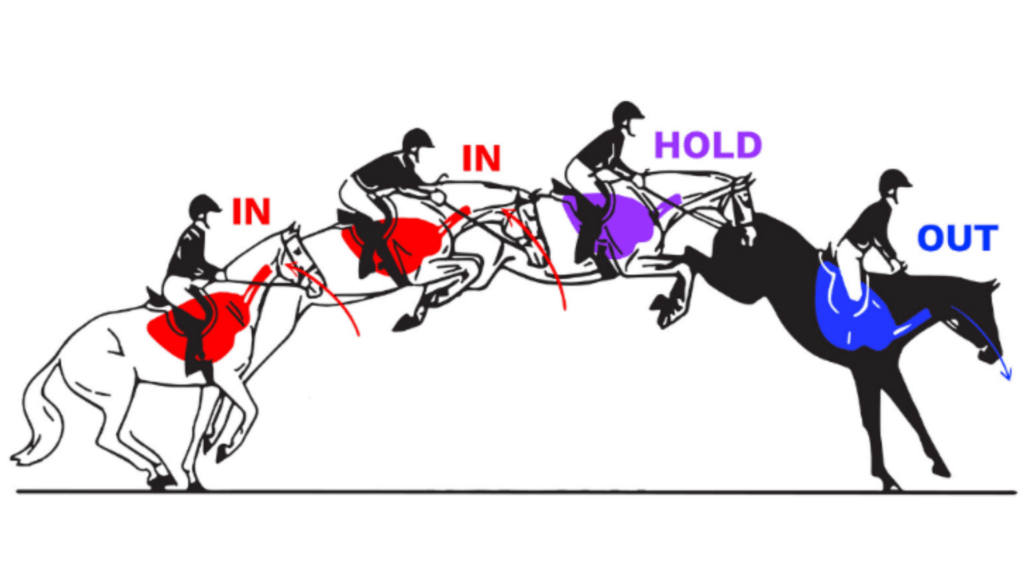
Horses hold their breath mid-air during a jump, only resuming breathing upon landing after the jump.
LONG-TERM CONSEQUENCES ON PERFORMANCE & CAREER LONGEVITY
Respiratory health is the second leading cause of poor performance (after musculoskeletal injuries). Over time, repeated exposure to high-intensity exercise leads to cumulative lung damage:
- 90% occurs gradually over a horse’s career due to repeated mild stress.
- 10% results from severe episodes during peak effort in competition.
This damage leads to scarring, thickening of blood-gas barrier, reduced efficiency in oxygen exchange, and impaired lung function and performance, shortening careers and diminishing long-term respiratory health.
PROTECTING YOUR HORSE’S RESPIRATORY HEALTH
To maintain peak performance, health, and extend career longevity, proactive respiratory care is essential:
- Ensure proper equipment fit to avoid airway restriction.
- Implement strategic training to build endurance while minimizing strain.
- Support the nasal passages to reduce collapse.
- Manage the environment to reduce dust, allergens, airway inflammation, and EIPH.
- Prioritize veterinary care to monitor and address respiratory issues early.
Why Horses’ Lungs Limit Performance
Horses are built for speed and endurance, but their lungs are the weak link in oxygen delivery to working muscles. Research confirms this by showing that supplementing inhaled oxygen during exercise can boost performance. Though selective breeding and training has improved function of the heart and muscles, the lungs do not demonstrate similar gains.
Unlike the heart and muscles, lung function doesn’t improve with training, as the volume of air being moved by the lungs is dependent upon the respiratory rate and breath size. A horse’s breathing rate is locked to its stride at the canter and gallop. The only way to increase oxygen intake is by lengthening stride and taking deeper breaths, but even this has limits. Training doesn’t increase the fixed size of the chest cavity or lung size, the maximum breath volume, or the surface area available for oxygen exchange.
How to Work Around Limited Lung Performance
Understanding that lung structure and function do not improve with training allows trainers and riders to focus on what can be improved. For example, the partial nasal passage collapse can be reduced with the use of a FLAIR™ Equine Nasal Strip. Performance gains in terms of increased maximal oxygen consumption or “aerobic capacity/fitness,” come from cardiovascular and muscular adaptations that enhance the efficiency of oxygen transport and utilization.
A mix of endurance and speed training optimizes energy production and use as well as performance across all exercise intensities (i.e. submaximal to maximal effort)—whether the discipline is primarily aerobic endurance or anaerobic sprints. This balance improves overall performance, stamina, and recovery.
IMPROVING CARDIOVASCULAR CAPABILITIES WITH ENDURANCE TRAINING: A MORE POWERFUL PUMP
Endurance training helps to:
- Boost blood volume, oxygen carrying capacity of the blood, and vascular dynamics that improve circulation to more efficiently meet the demands of working muscles.
- Increase strength, capacity, and pumping efficiency of the heart to increase the cardiac output and the amount of blood the muscles receive with each beat, keeping heart rates lower at a given speed versus unfit horses.
Improvements collectively enhance endurance, delay fatigue, and speed recovery.
IMPROVING MUSCLE EFFICIENCY: MAXIMIZING OXYGEN USE
Endurance training improves:
- Boost capillary or “tiny blood vessel” numbers, distribution, and network to enhance oxygen-rich blood delivery to working muscles, as well as their ability extract and use oxygen more effectively.
- The number of mitochondria or “powerhouses of the cell” and a greater number of better-functioning oxidative enzymes to generate energy for the working muscles.
- Promotes a shift toward efficient aerobic metabolism so that muscles rely less on inefficient anaerobic pathways, allowing more efficient fuel such as fat to be utilized, sparing valuable glucose and glycogen stores, enabling higher speeds for longer distances.
- Shift to aerobic metabolism also decreases production and accumulation of lactic acid, delaying fatigue.
- Improved thermoregulation due to more efficient energy production with less heat generation, earlier sweating and evaporative cooling, minimizing body temperature increases and reduction in overheating, delaying fatigue and quickening recovery.
- Improves the speed with which metabolic waste is removed from working muscles.
- Sprint training sharpens the body’s ability to buffer lactic acid, preventing muscle acidosis and delaying fatigue, extending peak performance.
- Mitigation of acidosis and hyperthermia of muscles further enhances oxygen transfer to the muscles that also delays fatigue.
FINAL THOUGHTS
Fit horses handle intense work—whether sprinting, hill training, or endurance riding—with greater ease, less respiratory distress or “blowing” versus the unfit horse, and recover faster. Improved aerobic fitness allows horses to rely less on anaerobic metabolism and regulate body temperature more effectively. This translates to allowing horses to go farther, faster, and finish stronger!
While the lungs don’t physically adapt to training and improve aerobic capacity, their efficiency improves as part of a well-conditioned system. The real gains in the respiratory chain – from the lungs to working muscles, comes from cardiovascular and muscular adaptations that enhance oxygen delivery, extraction, and utilization.
Maximizing a horse’s respiratory efficiency does require proper management, alongside a well-balanced training regime. Keeping airways healthy through environmental control, good husbandry, and targeted treatments—ensures peak performance, health, and long-term soundness.
Bottom line: Understanding these physiological limits allows us to train smarter and care for our equine athletes more effectively, ensuring they reach their full potential, remain healthier, stronger, and more competitive for the long haul.