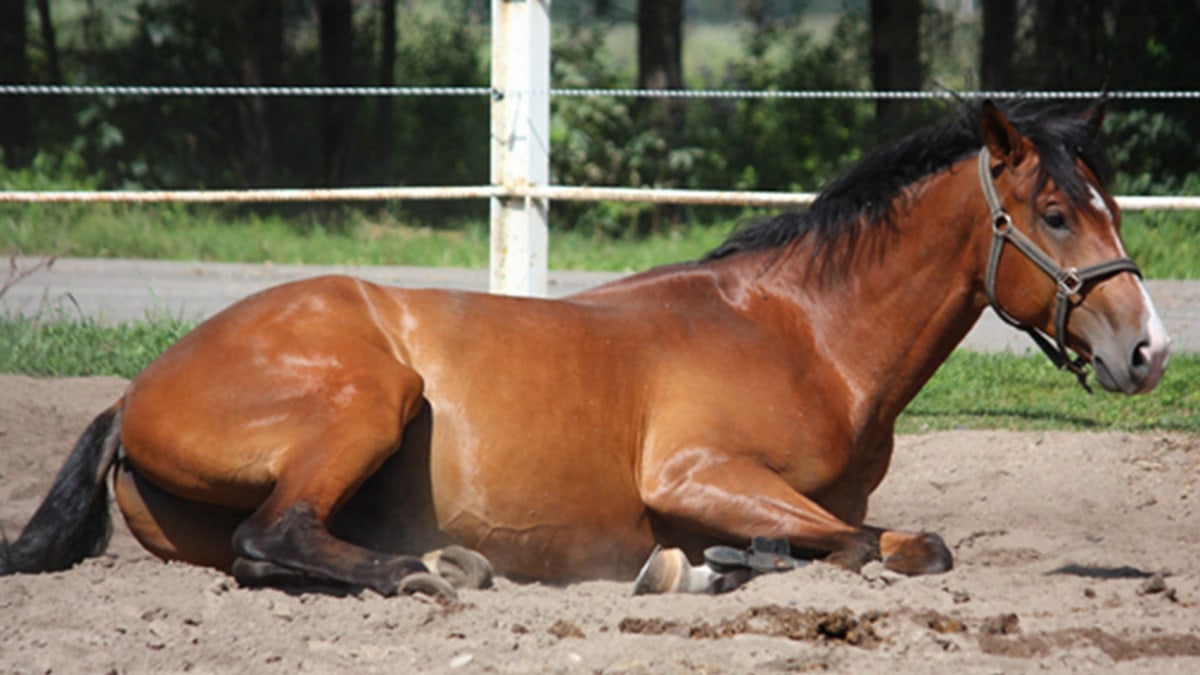
Our series Vet Essentials takes a look at some of the common health issues affecting horses. In this article, we take a look at the issue of colic, and explain why early veterinary intervention can be vital.
[bigbutton url=”https://horseandcountry.tv/app/details/training_and_learning_-_horse_health_and_wellbeing/Category514/991″ text=”Watch Vet Essentials: Colic here”]
All about colic
Colic is one of the most common conditions affecting horses and ponies in the UK, estimated to affect between 4 and 10 out of every 100 horses per year. The equine population seems to be more commonly affected by the condition than other species – this may be due to the long and complex structure of the equine digestive tract and the way it is arranged in the abdomen.
It is estimated that 1 in every 5 horses put to sleep over the age of 15 will be suffering from colic; second only to lameness as the most frequent reason for euthanasia. Therefore it is understandable that even the word ‘colic’ can strike fear into the heart of a horse owner. However, many cases of colic appear to be less serious and resolve with simple medication from the vet – how will you know if an episode of colic could be life threatening? And what is the best thing to do if you suspect your horse is showing signs of the disease?
What is colic?
It is quite common for horse owners to describe ‘colic’ as being one condition – with varying degrees of severity between cases. However, the term ‘colic’ really only refers to the symptom of abdominal pain; colic signs can represent dozens of different conditions affecting the equine abdomen. This means that ‘colic’ signs such as pawing the ground, looking round at or kicking the belly and rolling could be displayed if a painful process affects any abdominal organ, for example the kidneys, uterus or spleen.
In reality, most cases of colic will be as a result of a problem with part of the digestive tract: the stomach, small intestine or large intestine. If we consider that these conditions could range from mild intestinal cramps to the dreaded ‘twisted gut’, we can appreciate that some types of colic are of course going to be more serious than others and require very different treatments to try and resolve them.
Why can some types of colic prove fatal?
A ‘twisted gut’ is a layman’s term and covers a variety of the most serious types of colic: strangulations. In this situation, a piece of large or small intestine becomes twisted, knotted, trapped or inverted to the extent that its blood supply is cut off. When this happens, as well as being extraordinarily painful, the piece of intestine involved starts to die and toxins are released into the bloodstream. This causes the patient to become ‘toxic’ and circulatory failure and death are sure to follow unless a surgical procedure is undertaken.
An added problem with small intestinal strangulations is that the digestive fluid which continually flows through the intestine in a normal animal becomes obstructed and starts to build up in the stomach of a horse with twisted bowel. Horses cannot vomit; therefore the stomach can rupture if it becomes too full which again leads to rapid toxic shock and death. When a vet diagnoses one of these cases there are only two options: surgery or euthanasia. To ‘wait and see’ would cause unnecessary suffering.
Diagnosis and treatment
Essentially, when a vet attends colic emergency, their main aim is to establish the severity of the underlying disease process: will it resolve with medical treatment? Or will surgery be required for the animal to have any hope of survival. Understandably, this can be a very challenging and skilful task. The attending veterinary surgeon must piece together information that he or she obtains from the history and the clinical examination of the animal, in order to make a decision.
A vet will frequently perform a rectal examination if it is safe to do so and may also use the response to pain relief as an indication as to the severity of the problem. In some cases, the vet will need more information to make such an important diagnosis: passing a tube up the nose into the stomach; analysing a blood or abdominal fluid sample and in some cases performing an ultrasound evaluation.
This may take more than one visit to achieve and it is not always possible to conduct these investigations in the stable – some procedures such as the rectal exam can potentially be very dangerous for the vet and the handler – it may be recommended that the patient is transported to a veterinary facility.uckily, around 90% of colic cases respond to medical treatment, but the 10% that need surgery carry the best prognosis for survival if surgery is performed early. Colic surgery success rates have dramatically improved in the last few decades and often horses and ponies that have undergone the operation can make a full recovery and return to athletic function.
However, the chances of success will decline dramatically the longer the delay in referral to a surgical facility. It may be worth talking to your vet who can help you make the decision about whether colic surgery would be an option for your horse– so that if the situation ever arose you could transport your horse to a surgical facility without any delay.
The other place where time can be saved is calling your vet out in the first place. Often when you find your horse exhibiting signs of colic, you have no way of knowing when they actually started: finding them first thing in the morning could mean they have been in pain for 8-12 hours and time really will be of the essence so call your vet without hesitation.
What should I do if I suspect that my horse has colic?
It is impossible to tell just by looking at a colicky horse how severe the problem is. Call your vet as soon as you notice something is wrong – they can assess the nature of the disease by piecing together information obtained from a professional examination. Until the vet arrives, many horse owners will be aware that walking the horse can help to ease the symptoms. However, if the colic is serious, this can only serve to exhaust an already painful and distressed animal.
If they are in a lot of pain, they will also attempt to roll regardless of what (or who!) is in their way. This can result in injury to the patient and the handler or any bystanders.
Often, the best course of action is to put the horse in a stable or school with a soft surface or lots of bedding and remove anything that they could injure themselves on until the vet gets there. Your vet will appreciate a good ‘history’ so make a note of any previous colic episodes, any recent changes in management, when your horse was last seen behaving normally, and how the symptoms have changed since you first observed them.
Another popular myth is that the colicky horse must be prevented from rolling as it could cause a ‘twisted gut’. This idea really doesn’t add up as normal horses will roll several times a day if permitted without suffering any abdominal problems. Rolling in case of a colic is just a behaviour exhibited by horses trying to escape from a painful abdomen and should be allowed if it is safe to do so.
Can we prevent colic?
Owners often wonder if a case of colic might be their fault and if they have done something wrong. In the majority of cases, no specific cause is identified and it is likely to be just bad luck. However certain risk factors for colic have been identified, and owners who are mindful of these may be able to reduce the risk of their horse getting colic but will not be able to eliminate it: ·
- Change in routine: Introduce any changes in feed and routine gradually
- High worm burden: Talk to your vet about appropriate parasite control
- Lack of access to water: Reduced water intake can cause constipation; always make sure fresh clean water is available.
Summary
Colic is a symptom of many abdominal conditions, the majority carry a low risk to equine health but a minority require further treatment or are life threatening. You cannot tell by looking at a horse how severe the colic is so always call the vet. It is challenging for the vet to work out exactly what is wrong and they may not be able to do so at the first visit, but always be prepared for the fact that surgery may be required and have a plan in place to ensure the patient is able to get to a hospital quickly if necessary.
In the future, veterinary scientists hope to learn more about the reasons why particular types of colic occur; until then, practice good management techniques which may lower your horse’s risk of suffering from colic.
[bigbutton url=”https://horseandcountry.tv/app/details/training_and_learning_-_horse_health_and_wellbeing/Category3988/991″ text=”Watch Vet Essentials here”]