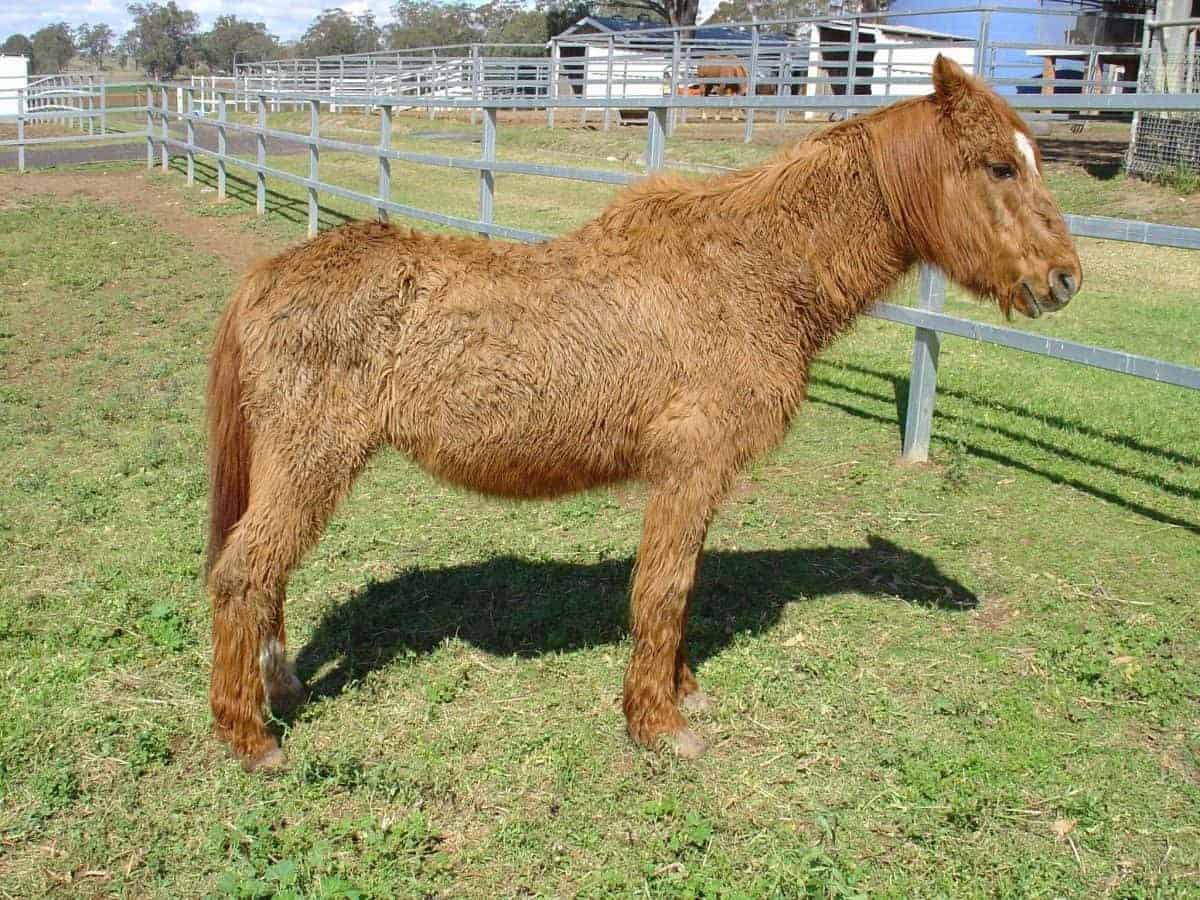
Our series Vet Essentials takes a look at some of the common health issues affecting horses. In this article, veterinary surgeon David Rendle takes a look at Equine Cushing’s Disease – also known as PPID.
Equine Cushing’s Disease is frequently cited as being the most common hormonal disease of horses. More correctly, the disease should be called Pituitary Pars Intermedia Dysfunction (PPID) because it is now known that the disease in horses is different from human Cushing’s disease, a pituitary condition named after an eminent human neurosurgeon Harvey Cushing.
Why does it occur?
The disease develops when nerve fibres within the brain become damaged. The nerve fibres that are most susceptible to damage run from an area of the brain called the hypothalamus to a gland at the base of the brain called the pituitary gland, and would normally cause a substance called dopamine to be released into the pituitary. Dopamine acts as an “off signal”, inhibiting the production of many hormones from the pituitary gland.
When the nerve supply to the pituitary gland becomes damaged there is less control over a part of the pituitary gland called the “Pars Intermedia” and increased quantities of certain hormones are released from this structure – hence the term “Pituitary Pars Intermedia Dysfunction” or PPID. The exact reasons why this nerve damage occurs are not known but it is clear that the damage becomes worse as horses get older. It has been suggested that horses and ponies that are obese may be more susceptible to this damage, and although there are logical reasons why this might be so, it has certainly not been proven. This suggestion does however provide a further reason, should one be needed, to tackle the UK’s equine obesity epidemic.
Which horses are affected?
We used to consider that equine Cushing’s was a disease of older horses, however research now indicates that the damage to the nerve fibres can begin quite early in life, frequently in the early teens and even younger. Two separate studies, one performed in Australia and one in the UK, have demonstrated that one in five horses over the age of 15 are likely have PPID and once horses or ponies reach their late twenties the majority are likely to have the disease.
What are the symptoms?
We are all aware that horses with Cushing’s develop excessive hair growth or retain their hair coat for longer after the winter. This condition is known as “hirsutism” or “hypertrichosis” and tends to affect horses with advanced Cushing’s disease. Unfortunately many of the earlier signs of Cushing’s that may affect horses in their teens or even younger are non-specific and easily missed.
Studies have shown that owners of ageing horses struggle to recognise the signs of Cushing’s. It may be that they are unaware of many of the early signs but also because it is difficult to notice the very gradual changes in their horse’s appearance and demeanour. Often these subtle changes are accepted as being part of the normal ageing process when in fact, if due to Cushing’s, could be partially reversible. Often these clinical signs are only appreciated as they disappear after the horse receives medical treatment.
Although many of the changes that occur in horses with Cushing’s are of relatively minor importance to the animal’s well-being, the major concern is laminitis. A recent study showed that horses with Cushing’s were four- to five-times more likely to suffer from laminitis. This risk may be higher in the autumn when hormone levels in Cushing’s cases get even higher.
Alarmingly, the first sign of Cushing’s disease may be the development of laminitis. This was highlighted recently by the loss of the Australian Olympic Dressage hopeful Victory Salute who developed laminitis at the age of 11 and was subsequently diagnosed with Cushing’s disease. Recent research has shown that around a third of laminitis cases have underlying Cushing’s and in one investigation performed in the United States the figure was 70%. In a study performed by The Liphook Equine Hospital in Hampshire looking at the situation in the UK, blood samples from laminitic horses tested by vets across the country were reviewed and it was found that 36% of laminitis cases had Cushing’s disease.
It is therefore very important that all but the youngest horses with laminitis are tested for Cushing’s disease. The percentage of laminitic horses and ponies suspected of having Cushing’s and subsequently testing positive is shown in the graph in figure 1; demonstrating that although the chance of an animal having Cushing’s as it gets older is heightened, younger animals should not be discounted. If Cushing’s is contributing towards the development of laminitis then the laminitis will not be controlled effectively without treatment of the underlying Cushing’s disease.
Other clinical signs of Cushing’s that are often more difficult to identify include:
- Muscle wasting
- Lethargy or poor exercise tolerance
- Increased drinking and urinating
- Abnormal fat deposition (often around the eyes) and insulin resistance
- Frequent infections
- Increased sweating
Hair coat changes are often subtle and frequently horses with Cushing’s have no obvious clinical signs.
What should I do?
Thankfully, the diagnosis of Cushing’s disease is relatively straightforward. A simple blood test to measure the level of adrenocorticotropic hormone (or ACTH) is all that is generally required. This hormone is usually produced by the pituitary gland in small amounts but when the normal nerve supply is lost the pituitary releases it in increased amounts that can be detected in a blood sample. Some early cases of Cushing’s can be difficult to detect and “stimulation tests” may be used to help confirm the presence of early or mild disease.
In addition to measuring ACTH it can be very helpful to measure insulin levels in horses suspected of having Cushing’s. Insulin gives an indication of the risk of laminitis in horses with Cushing’s and is an indicator of long-term prognosis. Insulin is also helpful in diagnosing the other major predisposing factor in laminitis, equine metabolic syndrome, so it is often sensible to test for both conditions at the same time. The autumn is a particularly good time to test for Cushing’s disease because affected horses have a much larger increase in ACTH concentration than normal horses. Ask your vet about testing for Cushing’s.
Cushing’s disease is a degenerative condition that cannot be reversed and will be present for life. Fortunately however, there is a proven treatment that is licensed for use in horses. The name of the active ingredient is pergolide. This drug provides the same signals to the cells in the pituitary that would normally be provided by the nerve fibres from higher up in the brain. A number of studies have demonstrated that this drug is the most effective treatment for the disease.
A recent study of over 2000 horses performed at The Liphook Equine Hospital showed that most horses’ hormone levels return toward normal within weeks of starting treatment. In horses that have mild or no clinical signs of Cushing’s but are positive for the disease and do not have a history of laminitis then there may not be a compulsion to treat Cushing’s disease. However, if horses are not treated owners must be aware of the increased risk of laminitis and ensure management and diet are under stringent control.
Questions are often asked whether herbal alternatives can be used to treat Cushing’s disease. The answer is simply no. There is no independent evidence available to suggest that they reduce the abnormal hormone production from the pituitary gland. This being the case it is hard to see how these products can do anything to reduce the risk of laminitis, the clinical sign of Cushing’s disease we are most concerned about.
In addition to drug treatment, horses with Cushing’s require extra attention to be paid to dental care, hoof care and parasite control. It should also be remembered that horses with Cushing’s are more susceptible to infectious diseases and therefore veterinary assistance should be sought early if there are early signs of infection or the horse sustains an injury. Most horses with Cushing’s develop insulin resistance and their diets need to be controlled carefully to further limit the risk of laminitis. If they are overweight then dietary restriction is especially important. In the long-term many horses with Cushing’s live out their lives happily with appropriate treatment and management. It is important that they are seen by a vet a couple of times a year and that their ACTH and insulin levels are checked to ensure that the treatment dose is still effective. Pergolide doses may need to be adjusted as time goes on.
Laminitis
We now appreciate that Cushing’s is an important factor in the development of laminitis even in younger horses. The classical signs of Cushing’s may not develop until the disease is advanced therefore blood testing should be considered to detect early cases and all but the youngest horses with laminitis ought to be tested. If you suspect Cushing’s in your horse or pony, talk to your vet for more information; with good management there is no reason why horses with Cushing’s cannot live a long and normal life and continue in normal work.
About the expert
David Rendle BVSc MVM CertEM(IntMed) DipECEIM MRCVS is a Veterinary Surgeon and Specialist in Equine Internal Medicine who works at Liphook Equine Hospital in Hampshire. In addition to being a large referral hospital, Liphook specialises in the laboratory testing of the hormonal causes of laminitis and carries out research in this area.
For more information, visit the Talk About Laminitis website