
A bridle is an essential part of your horse’s tack. It’s a series of leather straps that sit on your horse’s head, allowing the reins to be attached so the rider can control the horse’s movement. As it’s one of the main sources of communication between a rider and a horse, it’s vital that your horse’s bridle fits them properly and is up to the job.
The selection of bridles available is incredibly varied, with options to suit different-sized horses, disciplines, and more. So, how do you decide which bridle is best for your horse?
In this guide, we’ll cover everything you need to know about horse bridles, including:
- Parts of a horse bridle
- Types of bridles
- Which bridle is best for my horse?
- Fitting and adjusting your horse’s bridle

Parts of a horse bridle
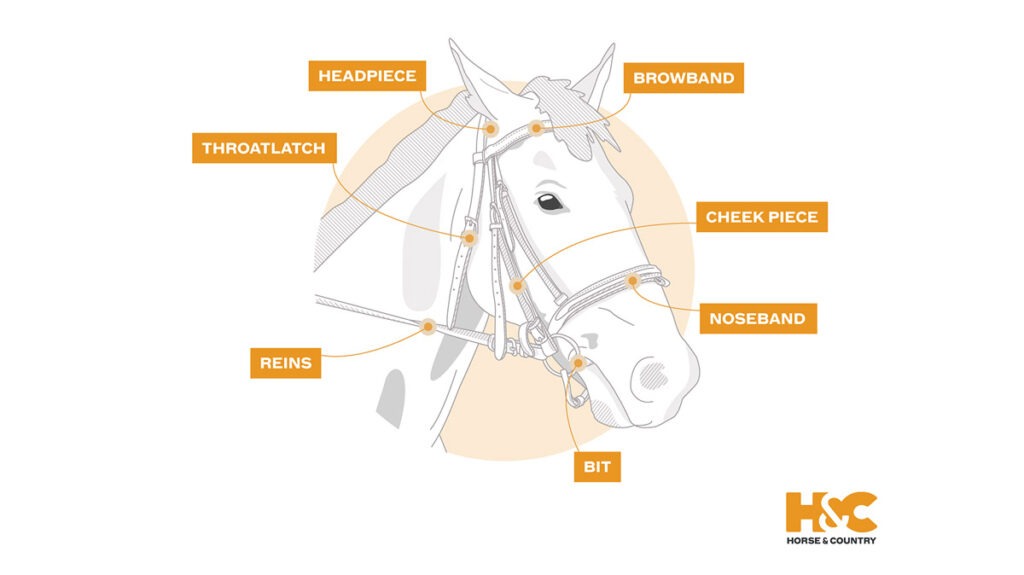
A bridle consists of various parts that connect together to help keep it in the correct position and ensure it is comfortable for the horse. While the types of bridles can vary in shape, they all have the following main components:
- Headpiece: The top part of the bridle that sits behind the horse’s ears and holds the bridle in place. You may also see it referred to as the crownpiece.
- Browband: The strap that sits above the horse’s eyes, below the ears. Along with the headpiece, it helps to keep the bridle in place on the horse’s head, preventing it from sliding back.
- Throatlatch: The strap that runs from the horse’s ears, across its jaw, and under its throat. The job of the throatlatch is to keep the bridle in place and stop it from slipping. It’s important that it’s not fastened so tightly that it restricts the horse’s breathing.
- Cheek pieces: The straps that run down the side of the bridle and connect the headpiece to the bit. They are the most important element of the bridle for communication. The cheekpieces can also be adjusted using buckles to ensure maximum comfort for your horse.
- Noseband: Sits across the horse’s nose and stops the horse from opening their mouth too wide and evading the bit. Nosebands come in various shapes and different types of bridles have different nosebands. The noseband often attaches to the bridle via a separate head strap, although some bridles (like an in-hand bridle) have a noseband that attaches to the cheek pieces.
- Bit: A bar (usually made from metal, rubber, or another composite material) that sits inside the horse’s mouth between its teeth. The bit has (at least) two rings on either side of the mouth. This is where the reins attach to the bridle and it is one of the main methods of communication between a horse and rider. As the bit puts pressure on the horse’s mouth and tongue, it plays to the animal’s natural urge to respond to the pressure. So, as the rider uses the reins to apply pressure to the bit, they can influence the direction of their horse’s movements. You can find out more about this in our guide to horse bitting.
- Set of reins: Formally considered part of the bridle, the reins are long, thin pieces of leather (or leather with rubber and/or fabric) that attach to the bit. These are what the rider uses to communicate with the horse while riding. When using a double bridle, the rider uses two sets of reins.
Types of bridles

Broadly speaking, there are two different types of bridles: English bridles and Western bridles. These are then split into further categories depending on fit and discipline. Western and English bridles are very similar in design, but Western bridles tend to be more lightweight than English versions and may not have a noseband or browband. Some Western bridles may also come without a bit.
While popular in the US, Western riding is not as common in the UK. For this reason, you’ll come across English bridles with more frequency in the UK, Europe and Australia. These tend to have a more complex style to allow for a great level of communication with the reins.
English bridles are available in a variety of styles determined by their noseband or bit. The three main styles are snaffle bridles, double bridles, and bitless bridles, but you may also come across anatomical bridles, which are available in snaffle, double, and bitless designs. Certain disciplines may also have their own bridle types, so you may also see dressage bridles and in-hand bridles. Below we’ll cover all the main types of bridles and their characteristics.
Snaffle bridle

This is one of the most common types of bridles and has one bit and one set of reins, making it the go-to for most styles of riding and disciplines. The snaffle bridle is suitable for a range of snaffle bits, including eggbutt, D-ring, and loose ring bits. They can also come with a variety of nosebands.
- Cavesson bridle: This style of bridle features a plain noseband strap and is one of the most common types of snaffle bridles you’ll come across. It’s popular for a multitude of disciplines as it creates a neat and put-together appearance.
- Crank noseband bridle: The crank noseband is similar to the cavesson but has a slightly different fastening in the form of a leveraged buckle. This allows for a tighter and more secure fit. The fastening of a crank noseband is also generally padded to help stop the buckle from digging in or pinching. This type of noseband has become particularly popular among dressage riders.
- Drop noseband bridle: Sits lower on the horse’s nose, below the bit, and in the chin groove. It’s intended to stop the horse from opening its mouth or crossing its jaw and evading the bit. For this reason, it’s often used for young horses when training them to accept the bit. Some horses prefer the feel of a drop noseband, while others will resist it.
- Flash bridle: This looks much like a cavesson bridle but has an additional strap that sits in front of the bit. It was originally invented so a standing martingale could be attached to the top cavesson band, while the bottom strap keeps the horse’s mouth closed.
- Grackle bridle: Also called the figure 8 noseband, a grackle crosses from the top of one cheek over to the chin on the other side, and the same on the other side of the horse’s face to form a figure of eight. Named after the 1931 Grand National winner, Grakle, you’ll mostly see these used for racehorses, but they can be used for other disciplines too.
- Sheepskin noseband bridle: An additional strip that can be attached to a cavesson noseband to prevent rubbing. They’re commonly used for showjumping and horseracing.
As different bits and nosebands serve different purposes, you may choose to have a combination that you switch out depending on the activity. For example, you may have a cavesson noseband for dressage and a flash noseband for jumping or eventing.
Double bridle
Also called a Weymouth bridle, the double bridle uses two bits: one small snaffle bit called a bradoon and a Weymouth bit, a type of curb bit that is connected to leverage shanks. This then means that two sets of reins can be attached for advanced control. As most riders only need one set of reins, you’ll mainly see double bridles used at higher levels of dressage.
Double bridles are especially useful for encouraging a horse to ride with a lower head carriage. The bradoon works just like a typical snaffle bit and helps to control the horse’s movements. The curb bit applies pressure to the tongue, chin groove, and neck. When a rein aid is used on the curb bit, the leverage shank applies pressure to the cheeks, which then applies pressure to the horse’s poll, encouraging them to lower their head.
A double bridle and the use of double reins needs very subtle aids to control the horse, and thus requires a well-established connection between the horse and rider. They are intended to refine a horse’s movement and carriage and should be used only when a horse rides consistently into the contact with good carriage and balance. It should not be used as an attempt to gain more control over a difficult horse, as being too harsh with the reins could cause injury. For this reason, riders should make sure they’re well trained in using a double bridle.
Bitless bridle

A bitless bridle is exactly what it sounds like: a bridle without a bit. Instead, the rider applies pressure to different areas of the head, such as the chin, nose, cheeks, jaw, or poll, to control the horse. This makes them a good option for horses with sensitive mouths or with a mouth injury.
There are several bitless bridle types available that work in various ways:
- Hackamore bridle: These apply pressure to the chin groove, nose, and poll. The reins attach via shanks which sit at the horse’s cheeks. As the pressure is concentrated around the muzzle, it’s worth noting that the hackamore bridle doesn’t allow much control over turning. If you’d like to use this type of bridle, you’ll need to make sure your horse is familiar with leg aids.
- Cross-under bridles: These have two straps that cross underneath the horse’s jaw. This applies pressure all around the head, rather than certain areas. As they’re very gentle on the horse, they’re great for new riders who are still getting used to the reins.
- Side-pull bridles: This type of bridle is similar to a bridle with a bit but applies pressure to the horse’s nose instead of the mouth. It’s most effective for applying turning cues rather than stopping signals.
- Rope halter: A rope halter (not technically a bridle) is rope knotted in certain areas to apply pressure to various parts of the face. These are most commonly used by Western disciplines and in horsemanship.
Anatomical bridle

Many traditional bridles have been known to irritate certain points of the horse’s face, particularly when poorly fitted. This is why you’ll often see them rubbing their face on their leg after a ride. Anatomical bridles are one way to prevent poor bridle fit. Also called comfort or ergonomic bridles, anatomical bridles are designed to fit around the contours of the horse’s head and distribute pressure evenly, relieving pressure on certain nerves. This creates a more comfortable fit for the horse, keeping them happy and healthy and helping them perform at their very best.
Most ergonomic bridles feature a higher nose band, which avoids putting pressure on nose muscles which could lead to numbness after prolonged wear. The head piece on an anatomical bridle also tends to be wider and padded, while the cheekpieces are cut lower to avoid sensitive facial nerves and allow for a greater field of vision.
Different brands and styles of anatomical bridle offer their own unique set of ergonomic features, so it’s worth shopping around to find one that suits your horse best. Many brands also offer comfort bridles suited to specific disciplines, such as anatomical dressage bridles.
In episode four of our Fit for Welfare series, ‘Bridle Fitting Know How’, we discuss the reasons for the rise in anatomical bridles. View the clip below and watch the full series here.
Dressage bridle
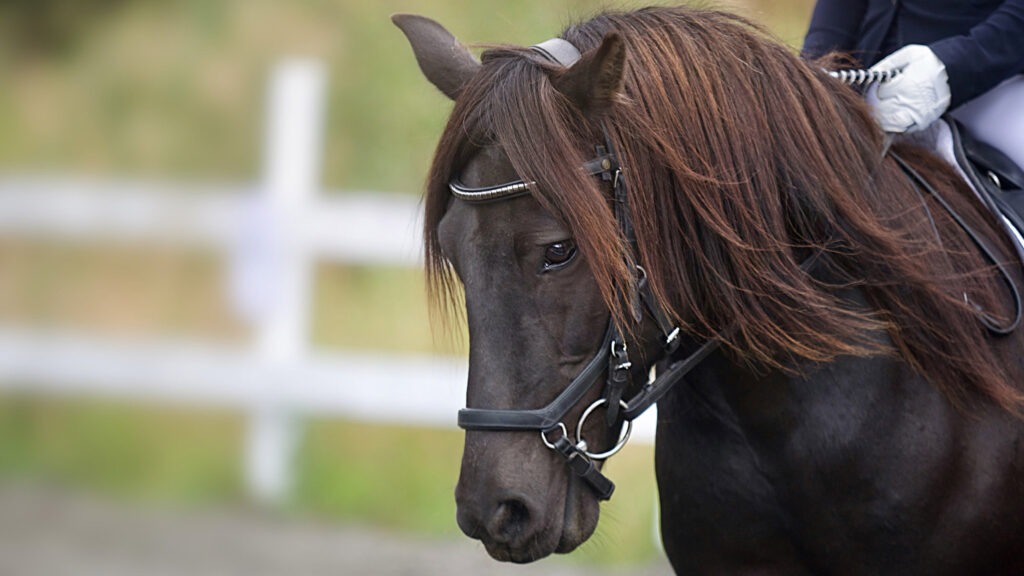
A dressage bridle is specially designed for dressage competitions. They are usually made from black leather with a padded flash noseband. The noseband and browband are also generally slightly more ornate than a basic bridle, which allows the horse to stand out more to the judges. Dressage bridles are also available as anatomical bridles to improve comfort and performance while competing.
In-hand bridle

In-hand bridles are designed to show off as much of the horse’s face as possible at an in-hand horse show. These look much like a cavesson bridle but the noseband fits directly onto the cheek pieces rather than requiring a second head strap. In-hand bridles may also include ornate stitching to really help your horse make a good impression with the judge!
Which bridle is best for my horse?
There are two factors you’ll want to consider when choosing which bridle is best for your horse. Size and fit is the most important, closely followed by style.
Bridle size
Bridles come in a range of sizes, including:
- Small pony
- Pony
- Cob
- Full
- Extra full (or oversize)
In some brands, you may also see large cob bridles, though these aren’t as widely available. While you’ll have a general idea of where your horse falls in this range, it’s a good idea to measure their head too, just in case it is slightly smaller or larger than the average for their size. This is especially important for breeds with naturally broad or short heads, such as Shetland ponies.
If you’re replacing an old bridle, you can take the measurement from the old one or ask your horse’s previous owner for their bridle size. If this information isn’t available, then you’ll need to gather the exact measurements of your horse’s head.
How to measure for a bridle
To find out what size your horse needs, you’ll need to take a measuring tape and measure the main points of their head.
- Headpiece: To determine the size of the headpiece, measure from one corner of your horse’s mouth, up and over their poll, and down to the other corner of their mouth.
- Cheek pieces: To measure for the cheekpiece, go from the corner of the horse’s mouth, up to the corner of their eye.
- Browband: For browband size, measure from the back corner of one ear, across the forehead, and to the back corner of the other ear. Be careful not to pull the tape too tight. The browband cannot be adjusted so it will need to be the right size to sit comfortably on your horse’s forehead. You should be able to fit two stacked fingers between the browband and your horse’s head, so you may want to factor this into your measurement.
- Noseband: For a noseband, measure the circumference of your horse’s muzzle one to two inches below their cheekbones where the noseband will sit. Again, you’ll want to make sure this is not too tight to prevent the noseband from rubbing.
- Throatlatch: You can determine the size of the throatlatch by measuring from the back corner of one ear, under the throat, and up to the corner of the other ear.
It’s worth bearing in mind that sizing can vary slightly between brands, so it’s best to choose the style and brand of bridle you want, then check their size guide to find the right fit for your horse. Head size is also personal to each horse, so you may need to look for separate parts to fit your horse properly. For example, if they have a slightly long face, then you may need to buy separate cheekpieces that are a little longer. Most tack shops or online retailers sell bridle parts so you should be able to find what you need.
For more information, make sure you check out our bridle fitting video with the Society of Master Saddlers. You’ll find even more videos in our Fit for Welfare series too, including saddle fitting advice and more.
Bridle style
Along with size, you’ll also want to choose the right bridle type for your horse’s comfort and your riding style. In most cases, you’ll be paying particular attention to the noseband and bit, choosing an option that suits your horse. This can take a bit of trial and error initially, as some horses like a lot of pressure while others are more sensitive. If they are known to refuse the bit, you may opt for a drop noseband bridle or even a bitless bridle. It’s all about finding the option that your horse performs the best and seems happiest in — so make sure to consult the help of your local bitting expert, if you are struggling to find the right fit.
If you’re starting out in dressage, showjumping, or eventing competitions, it’s worth bearing in mind that certain governing bodies have strict rules that dictate the style and colour of bridle that riders must use. These will be stated in the competition rules or members handbook.
If you’re part of British Eventing, you can view the Rules and Members Handbook online by logging into your account.
Fitting and adjusting your horse’s bridle
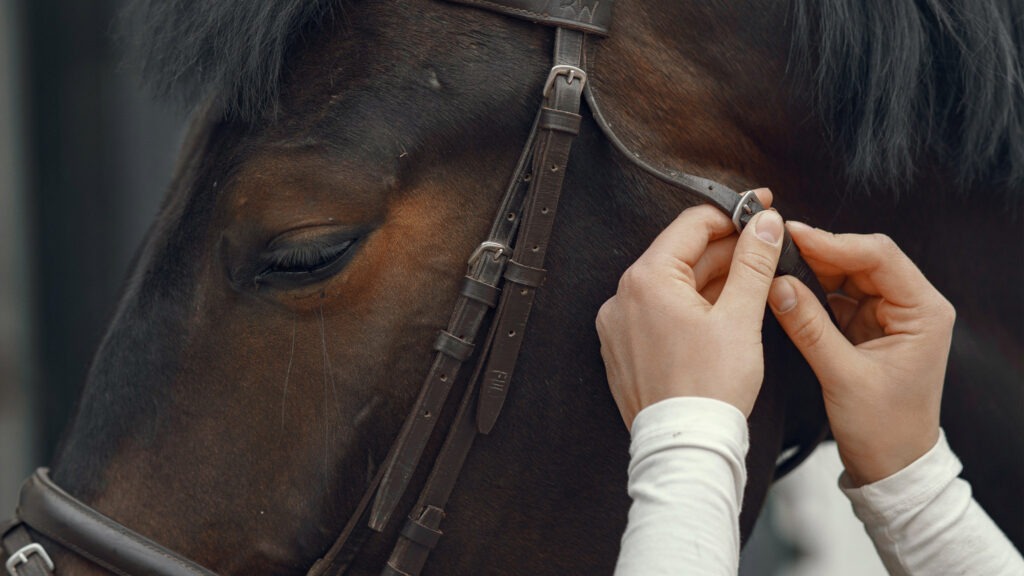
Once you’ve found a bridle that is the right size and style for your horse, it’s imperative that it is fitted to your horse correctly to make sure it’s as comfortable as possible.
Assembling a bridle
Your new bridle will need assembling before putting it on your horse. The video below from equestrian YouTuber Riding With Rhi explains how to put a bridle together in detail (plus how to take it apart for cleaning):
If you’re not sure what setting to have the buckles on, fasten them to the centre holes but don’t put them through the keepers. You can then adjust them properly once the bridle is on your horse.
Putting a bridle on a horse
With the bridle assembled, it’s time to put it on your horse.
- Stand on the left of your horse, slightly behind their eye, and place your right arm underneath their throat to keep their head in place.
- Hold the bridle over the horse’s nose with your right hand and, with your left hand, gently press on their gums in the gap between their teeth. This will encourage your horse to open their mouth, so you can slide the bit in (if you’re using one).
- Hold the bit in place as you pull the headpiece over their left ear and then the right ear, being careful not to bend the ears too much or pull the bridle too high, which could tug on the horse’s mouth.
- Pull the forelock over the browband.
- Check everything is straight then fasten the buckles for the throatlatch, ensuring the fit is just right according to the fitting steps below. If it’s too loose or too tight, use the buckles to adjust it.
Note: Not all horses are accepting of having their ears ‘threaded’ through the headpiece and browband as the ears and poll are very sensitive parts of the horse’s anatomy. You may find, depending on the horse you have in front of you, that you may need to build the bridle up on the horse rather than like the example above.
Fitting a bridle
If a bridle is too loose, it could slip and your riding aids won’t be effective. If it’s too tight, it will be uncomfortable for the horse. To check whether your horse’s bridle needs adjusting, use the steps below.
- Headpiece: The headpiece should sit so that the split between the headpiece and browband is just below the ears. If it’s too low, it will put pressure on the back of the ears.
- Browband: The browband should sit around an inch below the ears. Make sure it’s not too tight — you should be able to fit two stacked fingers between the leather and the horse’s forehead.
- Throatlatch: The throatlatch should be relatively loose, and you should be able to fit four stacked fingers between the strap and the throat, and the strap and the horse’s cheek.
- Cheek pieces: The cheek pieces should sit parallel to the facial crest, with the buckles sitting in line with the corner of the horse’s eyes. If the cheek pieces are fitted correctly, you should see one or two soft wrinkles at the corners of the mouth. Too tight and the bit will pull excessively on the horse’s mouth, but too loose and the bit will sit uncomfortably and collide with the horse’s teeth. Cheek piece and bit height is purely a matter of preference. Some horses like a tight bit, while others feel more comfortable on a looser bit, so be sure to adjust your bridle to what makes your horse happiest. We’d also recommend leaving at least one hole free in the buckle, so that if the leather stretches over time, you can adjust it.
- Noseband: Most nosebands (except the grackle) should sit around one or two inches (one or two fingers) below the horse’s cheekbones. If it’s too high, it will rub on the cheekbones, but too low can obstruct your horse’s breathing. You should also be able to fit two fingers underneath the noseband to check it’s not too tight or too loose.
- Grackle nosebands: For a grackle noseband, the padded circle should sit on the nasal bone, with the lower straps sitting in front of the bit and the upper straps resting just underneath or on top of the cheekbones.
- Flash nosebands: If you’re fitting a flash noseband, the flash should sit just below the bit, resting on the nasal bone at least six centimetres above the nostrils to allow the horse to breathe properly.
- Bit: To check that the bit is the correct size for your horse, lightly pull it out to one side. You should be able to fit your little finger in the space between the bit and the horse’s mouth.
Bridles are an essential piece of tack so it’s important to get them right. These tips should help you choose the correct bridle for your horse and your discipline, as well as ensure each part fits correctly to keep your horse happy and performing at their very best.
For more essential equestrian tips, be sure to take a look at our news, advice, and events section, which contains other horse care information, plus plenty of riding and training suggestions. To access hundreds of hours’ worth of exclusive video content, including training and advice videos, become a H&C+ member today.