
No matter what style of riding you do, maintaining a correct riding position is vital for you and your horse. As well as reducing the risk of harm for the both of you, finding the correct riding position puts the rider in harmony with the horse to make your overall ride both look and feel better. If you compete in dressage, you’ll know that adopting a perfect position is especially important, as the rider is marked on the effectiveness of their seat and overall position in the saddle.
However, a correct position doesn’t come naturally to all riders, and many will find it difficult to avoid slipping into undesirable habits due to weakness or lack of balance., So, it’s important to build healthy habits, improve your core strength and suppleness and adopt an independent seat to continually improve your position in the saddle. Fortunately, with practice and a few simple exercises, you can improve your riding posture and make it a natural position to slip into.
To help you find out what to do (and what not to do) when riding your horse, we’ve put together this guide on developing the correct horse riding position. Read on to find out more about the following topics:
- What a good riding position looks like: A checklist
- What a bad riding position looks like
- Exercises to help improve riding position
- Tips for improving your horse jumping position
What a good riding position looks like: A checklist
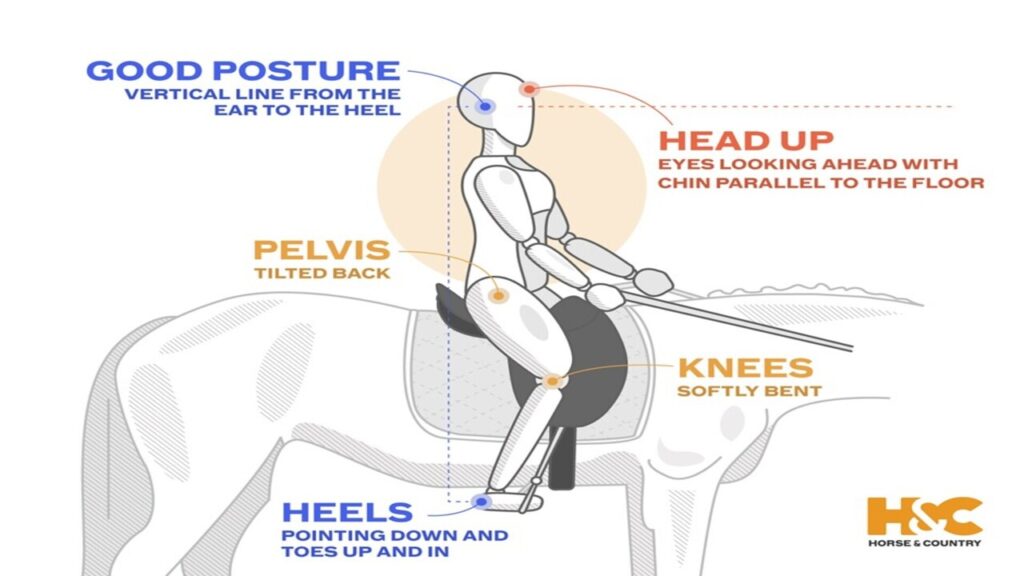 In order to improve your riding position, it’s important to know exactly what the perfect riding position looks like. Even the smallest body part out of place can make your position feel unnatural for both yourself and the horse. Here, we’ve broken it into small steps to help you get each detail right, from head to toe:
- Posture: There should be a vertical line from your ear, through to your shoulder, hip, and heel.
- Balance: Keep balanced by sitting equally across your seat bones to avoid leaning too much to one side.
- Head: You should keep your head up and be looking ahead with your chin parallel to the floor.
- Shoulders: Keep your shoulders down and square, and avoid rounding them or hunching them up.
- Chest: Keep the chest lifted and open to maintain good posture.
- Elbows: Keep your elbows soft, but ensure there is an imaginary straight line from your elbow to the bit, as if your forearms are an extension of the reins.
- Hands: Keep your hands upright to act as an extension of your forearm to elongate that straight line from the elbow, and ensure your thumbs are on top of the reins.
- Lower back: Keep this area flat to prevent arching.
- Pelvis: Keep your pelvis level and relaxed. This is what keeps the seat bones straight and helps you balance.
- Thigh: Lay your thighs flat against the horse and try to refrain from gripping too hard.
- Knees: Relax the joint and allow your knees to bend. Avoid squeezing your knees against the horse.
- Feet: The balls of your feet should rest on the stirrups, not push down into them. Keep the heel pointed down and your toes up and in.
To check your horse riding position, it helps to go through the details above one at a time as a checklist. While there are a lot of different aspects to consider, after enough practice they should become habitual when you ride your horse.
To learn even more about staying in the correct position, read on to find out some of the most important aspects to consider when riding your horse, including why they’re important and how to achieve them. You can also check out this position and positioning instructional video from Simon Grieve for more advice.
Balance
Balance is easily one of the most important factors when it comes to correcting your riding position. You’ll no doubt find it difficult to ride successfully with even the most well-trained and relaxed horse if you can’t find your balance. Aside from the obvious reason of helping you stay on the horse securely, being perfectly balanced can improve your performance, too. By maintaining your balance, you will be able to stay in rhythm with your horse, moving harmoniously as a team rather than separately.
You may also notice that your horse is much more receptive and willing to communicate once you adopt a correct riding position. This is because the more balanced a rider is, the easier the horse will find it to carry your weight, as otherwise they are forced to compensate for the rider’s crooked position. This can leave the horse feeling tense and uneasy, making it difficult to communicate .
You may find that your horse gives you signs that you’re off-balance through their behaviour, such as:
- Slowing down or coming to a complete stop when not instructed
- Speeding up and bolting off unexpectedly
- Over or under-compensating when it comes to turning, or turning the complete opposite way from where you instructed them to go
Not sure whether your balance is right or not? One of the best ways to test it is to push your reins forward. If this makes your position change, this is a sign that you have been using your reins to stay balanced rather than doing so naturally. You should also check that you aren’t pinching the horse with your knees to stay balanced. As well as being uncomfortable for the horse, this can also put you in danger if they act unpredictably. You should build a strong core and be able to balance without the assistance of the horse — core strengthening exercises can help you achieve this.
To make sure you’re perfectly balanced when riding, take the time before setting off to make sure that you’re sitting evenly on each seat bone and distributing your weight as evenly as possible. Keep your shoulders straight and look out for slouching, as this can easily make you lopsided. If you feel like you need practice finding your balance, try riding without stirrups as this encourages you to balance without relying you’re your reins. This can also be a good way to help your legs relax if you often find yourself gripping with them. You could also book a lunge lesson with a qualified instructor. This means you’ll be able to focus on your position while they control the horse from the ground, and they’ll walk you through a series of exercises to help improve your position.
Alignment
In order to achieve the correct riding posture, alignment is essential. Having poor alignment in your riding position can put stress on your body, especially your joints as the impact of the horse moving can put unnecessary pressure on them. Finding the right alignment is the best way to absorb this motion and keep you secure in the saddle. If you’re a dressage rider, you’ll have no doubt been told all about the importance of alignment for both your safety and the visual aspect, so you may already feel like an expert. But even if this is the case, taking some time to practice can help you elevate your skill and improve your riding position even further. Not already a dressage rider but interested in learning more? Give our dressage for beginners guide a read to find out how to get into the sport.
The pelvis is key when it comes to perfecting your alignment. You should make sure that it‘s stacked up evenly above the seat bones to improve your balance, and avoid pushing it too far forward as this can increase the risk of lower back discomfort and injuries. You should also make sure that your spine is straight and your head is in line to create the perfect vertical line from ear to heel. To get an idea of how your alignment is, ask a friend to come along and tell you where you may be going wrong. Or even better, ride in an arena with mirrors or ask them to take a picture so you can see for yourself.
If you’re struggling with perfecting your alignment, take it at a slow speed and practice on straight lines before taking on circles or faster paces. But if you’re more advanced and want to test yourself, try cantering while staying in perfect alignment. You may find this more difficult as it is tempting to twist your body. To develop good posture while riding the horse it also helps to improve your posture in everyday life — you can do this with regular practice and exercises.
After improving your alignment, you’ll no doubt feel more comfortable, confident, and balanced on the horse. You may also find that your horse is more relaxed. This is because working on your alignment will help you relax your body, too, which your horse will sense and respond to in turn.
Placement on the horse
To keep your horse as comfortable as possible while still maintaining the correct horse riding position, you should make sure the saddle is placed correctly. It’s important to check that the numnah and saddle is placed on the horse evenly to prevent them from becoming unbalanced. Make sure the saddle is balanced by lining the centre line up with the spine. Once your saddle is placed and secured correctly, you can use the riding position checklist above to get yourself into the correct riding position.
Placing the saddle on the right part of the horse’s back is vital – placing it too far forward can limit the shoulder motion of your horse, while placing it too far behind can be uncomfortable for the horse and make it more likely for the saddle to slip. The front of English saddles should be placed just behind the shoulder blade of a horse — you can simply use your fingertips to find out where this is. For Western saddles, place them slightly further forward and have them on the withers. It’s always best to have your saddle checked by a qualified saddle fitter if you’re in any doubt.
Biomechanics
It may sound a little complex, but understanding the basics of biomechanics can help you not only perfect your riding position but also understand how your horse’s body works better. Biomechanics in its simplest terms is studying how different parts work together to impact and produce movement. The study shows how much one small part of the body can have a major impact on the rest, without us even realising. Equine biomechanics can be used to study and explain a number of scenarios, such as how the positioning and symmetry of a rider, or the size and positioning of a saddle, can physically impact the horse.
If you’re looking to find out more about the subject, we have an informative rider biomechanics special with Colleen Kelly to teach you the basics, as well as an advanced biomechanics special. These handy videos go into detail on the importance of balance, posture, and coordination.
What a bad riding position looks like
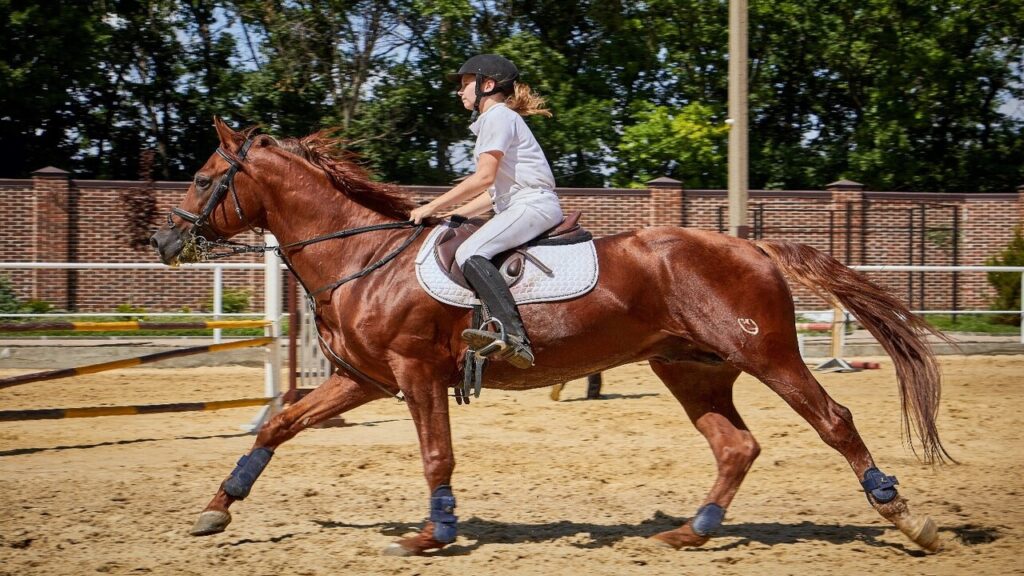
Considering there are so many different aspects to take into account when finding the right horse riding position, it’s no surprise that many riders struggle without enough practice. There are a number of small errors riders can make, and these can have a more significant impact than you may first realise. Below are a few of the most common incorrect riding positions you can easily fix with practice and the right exercises.
Slouched shoulders
Many people naturally slouch their shoulders in their regular posture, so it can be tempting to do the same while on your horse. But you should avoid rounding your shoulders and hunching over. Not only does this affect your overall seating position by altering your centre of gravity and making you unbalanced, but it also gives you less control over the horse as you won’t be able to use the reins effectively. Fix this by being mindful of your posture and sitting tall with your shoulder blades together, and even popping a whip across your elbows behind your back while you’re riding to encourage you to sit up.. You can also combat this by practicing good posture when you aren’t on your horse.
Looking down
This is a common issue that doesn’t just impact your posture but can lead you to lose focus and become distracted. When it comes to your horse riding position, looking down changes the position of the spine and will be bad for your alignment. Plus, looking up and sitting tall in the saddle can also help you sit deeper into the saddle so you have a more secure seat. So make sure to look up and ahead to correct your position and make the most out of your ride. It can help to imagine a floating object about 5m in front of you and following it round with your head and eyes.
Leaning forwards
When riding a horse, you may catch yourself leaning forward without even realising how you got there. It’s common for horse riders to lean forwards, especially in times of stress as it can make you feel more in control of the situation. However, if your horse stops unexpectedly while you’re leant forward, you’re much more likely to lose your balance or even come off the horse completely. So, while it may help you feel more in control, you’re actually in a much better position if you sit upright as this will give you the balance you need to confidently take control. It can help to imagine a block placed right in front of you to prevent you from leaning forward too much.
Chair seat
While feeling comfortable in your horse is a great situation to be in, you should avoid getting too comfortable and slipping into chair seat. Aptly named, chair seat is the opposite of the previous problem as it causes riders to lean too far back, as if relaxing on a chair. Doing this doesn’t just lead to incorrect riding posture and leave you unbalanced but it also causes your knees to come up too far and increase the likelihood of you gripping the horse with your knees. You can prevent chair seat by shortening the reins slightly to force yourself to sit more upright and practising standing up in your stirrups in walk because this will automatically place your lower leg in the correct position.
Poor hand placement
There are a few incorrect ways riders commonly place their hands. Your hands should act as an extension of your forearm, keeping a straight line from the hands to the elbow. The hands should be kept upright, with the knuckles vertical and the thumbs at the highest point. Perfecting your hand placement can be one of the more difficult parts of your horse riding position to master, but with regular practice and self-discipline you can make good hand positioning a habit.
A common mistake nervous riders tend to make is having their hands too high and too far forward, as they may feel being closer to the reins gives them more control. However, this makes the horse uncomfortable and forces the rider to lean forward. You may also find you are sometimes too heavy handed if your nervous or if you have poor balance and instead use the reins to prevent you from falling. This puts too much pressure on your horse, so you should attempt to fix this by keeping good posture and not relying on the horse to keep you balanced.
Another common problem is hands bouncing up and down while riding, a habit often caused by stiff elbows. This can be distracting and uncomfortable for your horse, so by improving your elbow position you may be able to avoid this issue.
Elbows out
Riding with your elbows out can sometimes make you feel more balanced, but in reality it has the opposite effect. Riding with your elbows stuck out also makes it more difficult to use the reins effectively as your arms will tend to move around involuntarily, giving you less control. It’s especially important for dressage riders as keeping the elbows in makes you look much more clean and elegant. You can correct this error by keeping your upper arms vertical along your torso, and keep a soft bend in the elbow to make you feel less rigid.
Exercises to help improve riding position

Practice is key when it comes to making the correct riding posture come naturally. If you make sure that each part of your body is in the correct position regularly, over time it will start to become a good habit. But if you’re looking for ways to test yourself even further, there are a number of exercises to do to improve your position both on and off your horse.
Riding exercises to improve your position
One of the best ways to work on your riding position is to get hands-on experience and do some exercises while riding your horse. There are a few different exercises for you to try out so you can mix it up each time. The exercises below target some of the most common errors:
- Look around: While in correct horse riding position you should be looking forwards, taking a few seconds to look around can actually improve your posture. You can see further behind you if you’re sat up straight as opposed to slouching. So every so often while you’re in a walk, look behind you as far as you can for a few seconds to straighten up your back.
- Hold a whip: If you’re looking to improve your hand positioning, whether you have bouncy hands or they drift and become too wide, riding while holding a whip horizontally under your thumbs will help keep your hands still, steady, and in the correct position.
- Toe rings: To build strength and improve your balance, take a foot out of your stirrups and use your toes to draw circles in the air, keeping your ankles straight.
- Standing stirrups: If you often find your heel raising up while riding, try standing upright in the stirrups and putting the weight on your heels. As a bonus, this can also help improve your balance too! Make sure to keep loose and soft joints when doing this move.
There are plenty of other ways you can improve your riding position too. Riding without stirrups every so often is a great way to encourage yourself to work on your natural balance, and asking someone to watch you and let you know when you slip into a bad position can be really helpful as well. If you’re looking for even more exercises for you and your horse, check out our guide to the best muscle-building pole work exercises.
Exercises for riders to improve their position
When it comes to being in the correct riding position on your horse, what you do outside of the arena can be just as important. As rider position is much more to do with the rider than the horse, it is the rider’s responsibility to work and improve on this. The good news is that you can often do this from the comfort of your own home. Yoga and Pilates are two great exercises to do in your spare time, as they don’t just build core strength and help you improve your balance, but they can also help you improve your flexibility and breathwork, too. Below are some of the most beneficial yoga and Pilates exercises you can do at home to improve your riding position.
Pilates exercises
The albatross: This pose works the upper back and shoulders, making it ideal for improving your posture. To do this pose:
- Lie flat on the ground face first.
- Squeeze your buttocks, lift your chest, and spread your arms out wide, while keeping your feet on the floor.
- Reach up as far as you can and hold for five to ten seconds, before gradually lowering yourself down. For more of a challenge, you can hold the position for longer and do small pulses.
Bridges: This exercise focuses on the lower back, as well as the glutes and hamstrings. To give this a go:
- Start on your back with your knees bent and feet on the floor.
- Lift your bottom up and push through your heels, until your body makes a straight diagonal line from your kneecaps to your head.
- Lay your arms on the floor and keep the heels directly below the knees.
- Slowly lower your buttocks up and down, for around ten repetitions.
Wall sits: This is a trickier exercise focussing on the core and glutes, but its great for your alignment so it’s worth giving it a go. You can do this exercise by:
- Stand with your back facing a wall, around two feet away. Have your feet parallel with your shoulders.
- Engage your core and slowly start to squat with your back right against the wall, until your thighs are vertical.
- Keep your knees above your ankles and keep them bent at right angles.
- Hold this position for around a minute (or as long as you can).
- Repeat five times, adding a few extra seconds to each wall sit if you want to challenge yourself.
Yoga poses
Tree pose: This is a great beginners pose, and perfect for working on your balance too. To try out this pose, simply:
- Stand with your feet together with your weight distributed evenly on each foot.
- Slowly start to lift one foot off the floor, then bend the knee and place the sole of your foot on the inner thigh of the opposite leg.
- You can have your hands at your chest, with your palms pressed together, or lift them in the air.
- Hold the pose for up to a minute (or as long as you can), and repeat the process with the opposite leg.
Downward facing dog: This classic yoga pose is great for stretching out the lower back to prevent you from slouching. Do this pose by:
- Get on all fours, with your knees behind your hips and your hands shoulder-width apart.
- Curl your toes under and slowly start to lift your knees and hips.
- Straighten your knees as much as you can, until your body resembles a V-shape.
- Push your pelvis up to the ceiling and ensure your feet and hands are still in the correct position.
- Hold for a minute (or as long as you can) before gradually releasing and going back to all fours.
Tips for improving your horse jumping position

It’s also important to know how to get into the correct jumping position. This is particularly crucial for your own safety to prevent you from losing balance and hindering your horse mid-jump. There are three main forms of jumping position to practice:
- Two-point position: Also known as light seat, this is the jumping position most riders start with, and therefore often feels the most natural. In this position, the only part of the rider in contact with the horse is their legs, which should be on the horse’s side. Their seat should be out of the saddle to give the horse ample flexibility, and they should bend forward at the hips, while keeping a good posture with a straight, unhunched back. This is useful when riding between fences, especially during cross-country when you need to reach higher speeds.
- Jumping fold: You’ll adopt this position when you take off for the fence. Like the two-point position the legs should be at the horse’s side, but you’ll fold forward from the waist and push back to maintain your centre of gravity. Your hands should stay soft and your lower leg will come forward slightly to help keep you on balance for landing.
In order to achieve the best jumping position, make sure to take the following advice into account:
- Spend time in jumping position when you’re not jumping to make it feel more natural.
- Check your stirrup length isn’t too long as you need to be able to get into a half-seat mid-jump.
- Don’t become ahead of your horse’s movement. Instead, wait for them to take off and then bring your hips backwards.
- If both you and your horse are experienced, try jumping with one hand to ensure that you are balanced and you aren’t holding onto the reins for support. Make sure to stick to a trot and only one- or two-stride distances.
- Watch other riders jump and take note of what they do. Seeing jumping the right way can help you figure out if there any aspects of your own position to improve. We have a variety of live events available for you to watch the professionals.
Just like with regular riding position, the best way to perfect your jumping position is with regular practice and dedication. And if you enjoy jumping and you’re interested in getting into showjumping, make sure to give our showjumping for beginners guide a read.
Being in the correct horse rider position is vital for the safety of you and your horse, and can make your ride much more enjoyable, too. Using the knowledge and tips above, you can practice both on and off your horse to correct your riding position and improve your posture.
If you’re looking for more riding tips and inspiration, we have a great range of training and advice videos to help you learn more, as well as handy beginner’s guides such as our beginner’s guide to eventing. And if you subscribe to our service you can get even more great equestrian content, including series and shows and coverage of live events. Check out all of what we have to offer today.